Here are some shorter items I’ve been saving up.
1. Orthodox “Advent”
I put “Advent” in quotes, because it is nowhere found in Orthodox texts, though it is sometimes used as a popular nickname.
I loved Anglican Advent. It begins with a flourish on the fourth Sunday before Christmas: the vestments go violet or blue, the Scripture readings for the next four Sundays are clearly on the theme of Christ’s coming Incarnation, as are the hymns, like this ancient “Western Orthodox” one. This is the best of Anglican music, from King’s College, Cambridge England. (I still get homesick at this time of year.)
In Western Christianity there is no Advent Fast. Once there was, often called “Saint Martin’s Fast”, because his feast day is November 11 – which is to say, they kept a forty-day Fast just as we still do. The last remnant of it disappeared in the Roman Catholic Church in the early Twentieth Century.
The Orthodox season of preparation for Christmas is very different. My first year as an Orthodox Christian, I kept wondering “Where’s Advent?” We retain a forty-day “Nativity Fast” beginning on November 15.
If you’re in a monastery or if you come to Sunday Matins (Good idea. Try it sometime!) you’ll hear some music for the Nativity, anticipating the Feast.
However, at Sunday Liturgy there is no notice, except that the vestments go red. Why red? I’ve heard the explanations: blood, martyrdom, fire. What’s their special connection with Advent?
Finally on the Fourth Sunday before Christmas, at Divine Liturgy we hear this single lovely Kontakion: “The Virgin Comes Today”.
This is in Greek, but you can read the text.
On the two Sundays before the Nativity, we celebrate the Ancestors and the Forefathers of Christ. On the last Sunday, the poor priest or deacon has to read the Genealogy of Christ: Matthew: 1:1-25. Read it yourself and take pity on him.
Finally, on December 20, Orthodox get serious and begin the season of the Forefeast of the Nativity.
Why these stark differences, East and West? Because Orthodox liturgical development stopped by about the Tenth Century * – apparently before it occurred to anyone to make a big thing out of Advent – while it kept developing in the West for a long time after that, and in fact, it still is.
- You new Orthodox: You wanted something unchanging? You’ve got it!
2. Why does Santa Claus wear red?
It’s because of Saint Nicholas. Probably you know that story. I’ll tell it again a little later, no matter. But that raises another question:
Why does Saint Nicholas always wear red?
It’s not clear. Saint Nicholas died on December 6, 343, scarcely a decade after the persecution of Christians had ended in the East. Bishops had now come out of hiding and were beginning to wear vestments. What color vestments did Saint Nicholas wear? * At that point I’d guess whatever he could find.
-
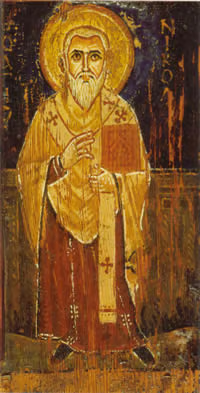
Courtesy of Saint Nicholas Center (sticholascenter.org). an excellent source of information about the saint. - The Orthodox liturgical color scheme came into use much later, and in many places is still not fixed.
Most icons from the Eastern world were destroyed by the iconoclasts in the Eighth and Ninth Centuries. The earliest surviving image of Saint Nicholas is from the Eighth Century: part of a larger composite icon, now preserved at Saint Catherine’s Monastery on Mount Sinai. Note the red.
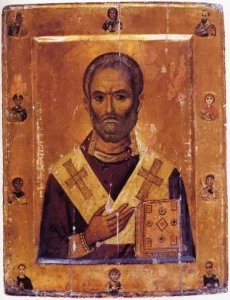 The earliest surviving icon of Saint Nicholas alone is from the Tenth Century, also preserved at Saint Catherine’s Monastery. Very dark red?
It was apparently normal for icons and images of Nicholas to show him dressed in red. There’s no point in showing you Orthodox icons of him. You see them all the time.
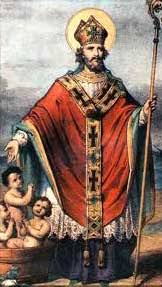 However, here is a typical Roman Catholic picture of him:
Why red? Nicholas was not a martyr. A tradition says he suffered during the Great Persecution, but so did other saints who are not consistently shown vested in red.
So here’s our Orthodox answer to everything we can’t figure out: It’s a mystery.
Santa Claus emerges.
Saint Nicholas quickly became one of the most popular of saints. In Western Europe he was said to bring gifts on December 6. * In Orthodox countries, Saint Basil brings gifts on January 1. (I’ve read about a plastic Santa who, if you pulled his string, cried “Saint Basil is coming!” Cultural fusion.)
- Here in Milwaukee, with some people of German descent, Saint Nicholas still brings little gifts on Saint Nicholas Day. We did this when our children were little.
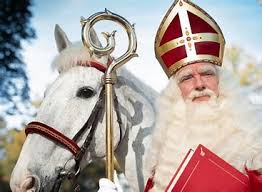
As you know, after the Reformation, Protestants no longer venerated the saints. However, Saint Nicholas was so popular that there was no getting rid of him. He became, for example, SinterKlaas in Holland, still wearing a Western bishop’s mitre and dressed in red. The Dutch brought him to New Amsterdam (later New York) where he remained popular.
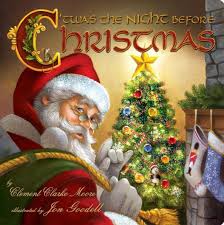
Then in 1822, Clement Clarke Moore, an Episcopalian seminary professor, wrote a poem, A Visit from Saint Nicholas (“’Twas the Night before Christmas”), restoring his English name, but turning him into a tiny, fat, jolly Norse elf who came from the North Pole bringing gifts at Christmas. * He was still dressed in red and wore what had once been a bishop’s mitre. The poem became immensely popular. And that was how Christmas became gift-giving time in America.
- Moore was from my seminary. I apologize.
At the end of the Nineteenth Century, the little elf was transmogrified once again into a full sized elf called Santa Claus *, sometimes still called Saint Nicholas.
- Saint Nicholas = SinterKlaas = Santa Claus. Say them three times fast.
For some years Santa Claus remained a sort of mystical figure. 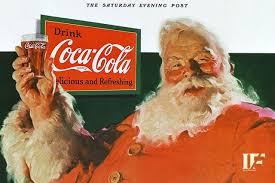 But in 1931 he began selling Coca Cola, and then the flood broke loose… and today, during the weeks before Christmas, Santa Claus is on television selling M&M’s, Oreo cookies, Wendy’s Peppermint Frosties, Pillsbury cookie dough, Red Bull energy drink, Dunkin’ (doughnuts), Sears Black Friday deals, Old Navy apparel, Capital One Shopping cards, Greenies dental treats for pets, merchandise at Dollar General and CVS and much more – still dressed in the red of our Holy Nicholas.
Parents, why don’t you try to make something of Saint Nicholas Day? Don’t discourage little ones from believing in Santa Claus, but when they finally ask “the question”, be prepared to tell them about the real Saint Nicholas.
P.S. With the present rate of global warming, the North Pole will be open water in a few decades. I hope Santa and his elves are making plans to migrate to the South Pole.
3. Once Upon a Time
From the plaque at the foot of 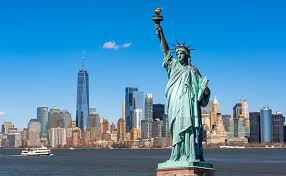 the Statue of Liberty:
“Give me your tired, your poor,
Your huddled masses yearning to breathe free,
The wretched refuse of your teeming shore.
Send these, the homeless, tempest-tost to me,
I lift my lamp beside the golden door!”
Emma Lazarus, November 2, 1883
4. Pope Leo XIV
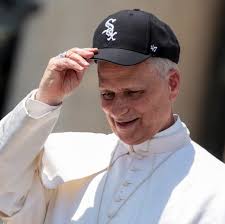
“Someone who says ‘I am against abortion but I am in agreement with the inhuman treatment of immigrants in the United States – I don’t know if that’s pro-life.”
I wonder when our Orthodox hierarchs will speak up.
That’s a Chicago White Sox cap. Pope Leo grew up only a few miles from where I was serving as a priest in the Episcopal Church.
5. It’s Advent. Let’s Fast. Let’s Feast?
There was a time when, for all Christians, Advent was a quiet period of preparation for Christmas, which arrived on December 25. Then began the Days of the Christmas celebration..
Times have changed, to put it mildly. “Back in the old days” (my favorite line at my age), Christmas trees were usually set up and decorated on December 24, generally after the children went to bed. I remember, when I was little, what a thrill it was to wake up and run downstairs and see a lighted tree! “Christmas has come!” You can still  see this in old movies. When our kids were little, we put our tree up early, but to this day we use only blue lights till Christmas Eve, then the colored ones.
Commercial Christmas has long taken over: It begins about Thanksgiving, when Santa Claus arrives selling merchandise, and it’s over at midnight on December 25. You can tell because all the Christmas movies suddenly vanish from our television screens.
How can we keep the Orthodox Fast while everybody around us is Feasting? Please do not tell people “I’m Orthodox. I can’t eat that.” or “I’m Orthodox. I can’t come to your party.” Christ commanded us not to call attention to our Fasting. Eat what they give you, keeping the Fast as best you can. But do not give up on the spirit of the Fast: quietly give up a little something else you like.
Then at home do something to emphasize and celebrate the Days after December 25. You could save a few of your kids’ Christmas gifts for the Days of Christmas? * Throw a Christmas party for your Orthodox friends; include potential Orthodox, of whom there are many right now. Be inventive.
- If you can get by with it. We did this. Our son David loved it. Our daughter Jennifer hated and despised it!
Advent is a time when we Orthodox can practice being counter-cultural, for we must learn to be counter-cultural in much greater ways if we are to attain to the Kingdom of Heaven.
6. Ortho-bros?
For any readers here present who are completely out of it, “Bro” is slang for “brother”, used for a close male friend. “Ortho-bros” are young male friends within the Orthodox Church.
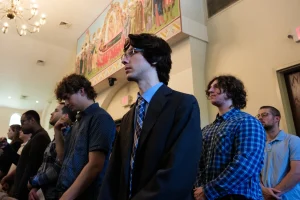
This past November 18, The New York Times had a well-illustrated article titled “Orthodox Church Pews are Overflowing with Converts” *, emphasizing how the Orthodox Church is attracting many young men who are seeking a Faith that challenges them. The article left the impression that Orthodoxy appeals chiefly to males. When my wife read it, her reaction was: “The writer doesn’t know much about Church, and even less about Orthodoxy.”
- Wow! Did we ever think we’d live to see that headline?
It is true that for several years the Orthodox Church has been attracting many new young people. At first it was called a “Surge” of young men. However, lately there is a “second Surge” of young couples and families.
At our Saint Nicholas Church, in Cedarburg, Wisconsin, every Sunday new people are showing up . * Most come back again; many become catechumens and in time are Baptized or Chrismated into the Holy Orthodox Church.
- I have noticed over the years that often the husband catches the “Orthodox bug” first, then later his wife, who frequently becomes even more enthusiastic than he is.
What are we doing to attract them? Nothing. Absolutely nothing. That’s part of what attracts them. They say they want religion that is ancient, based in Apostolic Truth, and solid, * that doesn’t bend with the winds of the times, or change every time they listen to our national “higher-ups”, or vary from place to place when they search on social media, (I’ve searched the purported news and music on YouTube lately, and am amazed how much of it is fake, created by AI.)
- Brace yourself. I’m going to tell it again: Q. “How many Orthodox does it take to change a light bulb?” A. Chaaaaange?!?!!!
I have never heard the term “Ortho-bro” here at Saint Nicholas. If there is a group of young men finding Orthodoxy at the same time, I can see it as a term of endearment and support, as they grow into the Orthodox Faith together. Of course, some new converts can become “super-Orthodox” for a while, till they settle in. Be patient. (Was I ever guilty of this? Well,… …)
However, there is also a different sectarian kind of “Ortho-bro”. In a Comment to my earlier Post about Charlie Kirk, someone asked whether a man named “Jay Dyer” is a kind of Orthodox Charlie Kirk. I’d never heard of him, so I’ve done some research.
Jay Dyer is an “online influencer” * who has gathered “Ortho-bros” around him, and has built up a kind of online “pseudo-Orthodox sect”, from which apparently one can be “cast out” for speaking heresy, by Dyer’s standards. Of course, there’s much we’d agree with in what Dyer teaches. All Orthodox agree that the Orthodox Church is the “true Church” – that is, the Church that is still on the mark, authentic and true to the Gospel of Jesus Christ in a way that others are not. Otherwise we wouldn’t be Orthodox.
- “A personality with credibility and a dedicated audience on social media”. In this case I’m so out of it I had to look it up.
I call Dyer’s “Ortho-bro” group pseudo-Orthodox and sectarian, because it has no apparent relationship with the actual Orthodox Church. Where is Dyer’s parish? Who is his bishop? Is he responsible to anyone at all? Dyer appears to be a dis-attached loose cannon. (He’s not the only one. Be careful.)
Unlike Charlie Kirk, Jay Dyer has several degrees. He lectures brilliantly. His approach is what I call “hardshell Orthodoxy”: no truth outside Orthodoxy as he understands it, which is narrow, polemical, eager to put down any who disagree with him – sometimes, I read, in a nasty, crude way.
P.S. Saturday December 13. Here is part of a comment just sent in response to this Post. “Saint Paisios said it best, ‘The way of the Church is LOVE. It differs from the way of the legalists. It sees everything with tolerance and seeks to help people.’”
 Dyer emphasizes what might be called “hyper-masculinity”. Here, for example, is how he proclaims his masculinity, advertising a debate between a Roman Catholic scholar and himself. (My reaction: What on earth is wrong with this man? He is married, just in case you’re wondering.)
Equally disturbing, Dyer identifies Orthodoxy with extreme alt-right American politics. He supports the Russian invasion of Ukraine. He has filled in for the well-known podcaster Alex Jones, who promotes conspiracy theories and hoaxes, claimed for years that the Sandy Hook school shooting never took place and that the parents were hired actors. Jones was sued by the parents for $1.5 billion, and declared bankruptcy.
Dear “bros” and sisters, too:
If you are looking for Orthodoxy on-line, good! That’s how many are first discovering the Faith these days. But please avoid these self-appointed pseudo-Orthodox authorities like the plague.
If you are involved with them: Please widen your horizons. Get yourself offline *, and go to an Orthodox church. That’s where you’ll find real Orthodoxy. Worship with the Orthodox. Know Orthodoxy as it actually is: a community with women around – strong women, believe me! – and babies crying at Liturgy and parish festivals and a whole variety of people. Get involved with Orthodox charitable work. Get to know “cradle” Orthodox people who know more about real Faith than do these online “influencers”. Find out what Orthodoxy is really like.
- except for this Blog, of course!
7. Orthodoxy: a Peoples’ Church
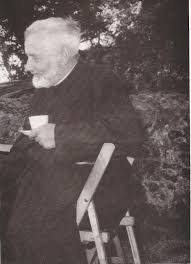 In the 1940s Father Derwas Chitty * was a faithful priest of the Church of England, who loved Orthodoxy and hoped that Anglicanism and Orthodoxy could one day be united. (It did not look entirely impossible in those days.) Here is an insight from his pamphlet Orthodoxy and the Conversion of England which helped enlighten me in my journey 35 years ago:
“This Church which at first sight appears so highly hierarchical is much more of a layman’s Church than either ours or the Roman.”
- You are allowed to praise God that this is not your name.
Next Week: Wisdom from Antiochian Metropolitan Saba: Orthodoxy – Masculine? Feminine?
Week after Next: Orthodox Music for the Nativity of Christ
Dear Fr. BIll, with all the frenzy building up to Christmas in Orthodoxy as well as the RC and Protestant worlds, it all comes to a screeching halt on December 25 except for the Christmas Kontakion which ends five days later on December 31. The Christmas hymns refer that the Theotokos is proceeding to Bethlehem and once there the hymns announce the birth and then say no more other than the Kontakion as I mentioned. Your thoughts would be welcome on this direction in the Typikon since after Easter we celebrate for forty days! In Christ, Fr. John
Thank you for writing, Father John. Forgive me for not responding quickly. “The frenzy building up to Christmas” is my only excuse.
I am no liturgical scholar. However, judging by what the liturgical books provide, the feast of the Nativity of Our Lord is apparently expected to be a slightly lesser feast, building up to the somewhat greater feast of the Epiphany – which has been nearly lost in the modern world. I wrote about this some years ago: https://frbillsorthodoxblog.com/2018/01/05/poor-epiphany-poor-us/
(In process of searching for this, I discovered that AI provides a summary of each of my Posts! Oh, help… This one, at least, was accurate.)
Following the After-Feast of the Epiphany, there’s nothing else on the “Infancy” theme till a kind of “flash-back” forty days after Christmas on February 2, the The Meeting with Simeon.
But then come the forty days of Pascha with the Paschal apolytikion/troparion sung every day. What is the Church saying? That Pascha is by far the greater celebration and of the greatest importance. Without Christ’s Resurrection, we would never understand what happened in Bethlehem.
Exactly how did these feasts come to be celebrated as they are? Ask a liturgical scholar, and you’ll get an accurate description of a complex, sometimes almost haphazard, historical process. However, I think the real answer is: By the hand of the Holy Spirit.
Father Bill
Father, bless! I was the person who commented about Jay Dyer. Forgive me for being lax in replying to your comment. Thank you for diving into this and I appreciate your thoughtful research and remarks. I think Saint Paisios said it best, “The way of the Church is LOVE. It differs from the way of the legalists. It sees everything with tolerance and seeks to help people.” Lord have mercy on us sinners. I see many young men coming to the Church through Jay Dyer and I pray for them.
Thank you, Maria. I’m going to take that quote from Saint Paisios and add it to the text of the Post. God bless you.