Here’s where we are:
This week there was no Wednesday or Friday Fast. If you forgot: Quick! It’s already past 5 pm CST. Grab a cheeseburger! preferably the healthy kind like my wife makes – is now making!
Next week: normal fasting.
Meatfare Sunday, February 15: last day for meat till Pascha.
Cheesefare Sunday, February 22: last day for cheese, eggs and other animal by-products, also wine and oil.
Clean Monday, February 23: The Great Fast begins.
I once described Orthodox fasting rules to a non-Orthodox friend, who asked incredulously “What do you eat?” I said “Roots and berries” – in jest, of course. Really, vegan food can be delicious *, and it keeps us right in fashion these days! and also healthier.
- The purpose of Lenten fasting is not to make us suffer.
A warning to you new Orthodox: If you’re not accustomed to fasting, start slowly. Don’t try to do the full Lenten Fast yet. A warning to old Orthodox: Make sure you get sufficient protein and calcium.
More about this next week.
Now, this Sunday Saint Paul has important things to say about fasting.
Please read the texts before we proceed.
Epistle for the Second Sunday of Pre-Lent: I Corinthians 6:12-20
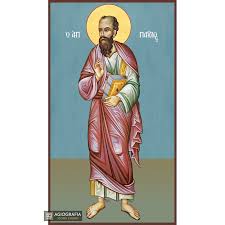
Paul begins: “All things are lawful for me, but not all things are helpful. All things are lawful for me, but I will not be brought under the power of any. Food was made for the stomach and the stomach for food, but God will destroy them both.”
What Christians should eat or not eat – these were big issues in the early Church. Those of Jewish background or sympathies were tempted to return to the Old Testament Fast: no pork because pork was unclean, and so on. Also there was the meat market issue. Animals were sacrificed in pagan temples, then the meat was sold in the market. Should Christians eat such meat? In both cases Paul had said: Eat it. Christians aren’t bound by Old Testament regulations, so eat the pork. Idols have no real existence, and God made all things good, so eat the meat. “All things are lawful.”
Apparently Paul had told them this previously. Some Christians in Corinth (described by one of my professors as “Paul’s problem parish”) misinterpreted things as they usually did, and said: Hooray! No restrictions. Pork is legal, so let’s pig out. If drink is good, hey buddy, let’s have another one and another and another. And if sex is lawful, well… …! No, No, No! Paul is saying to them here. That’s not what I meant. “All things are lawful, but not all things are helpful.” Things can be legal but still dangerous. It’s legal to down twenty shots of whiskey in a row, but…
Here are some things to keep in mind as we go into the Great Fast.
1 Eating meat during Lent is neither immoral nor illegal. “All things are lawful.” We Orthodox have never had any of this “eat meat on Friday and you’ve committed a mortal sin” stuff.
2 Western Christians historically have had fasting laws which were minimalist: “Here are a few things you must do”. * Orthodox fasting rules are maximalist – high goals to aim for, as best we can. Orthodox fasting rules are guidelines which may be adapted as necessary to our situation.
- Today Western fasting laws are so minimal as to be almost non-existent.

3 Fasting is “helpful”. It has several purposes: Fasting is a tool to be used to help us gain self-control. Fasting expresses the restrained, penitential tone of the Lenten season, as we wait for the Paschal Feast. Fasting together helps unite us as a community. Setting aside some good things, like pleasing our palates, helps us focus on what is better and what is best, on God and people and saving our souls. Leaving our stomachs not quite full helps us to empathize (not just sympathize) with all the hungry people in the world who “fast” by necessity.
I been wanting to talk about empathy (the ability to understand and share the feelings of another), and this is an apt time.
- Elon Musk: “The fundamental weakness of Western civilization is empathy.”
- Albert Einstein: “Empathy is patiently and sincerely seeing the world through the other person’s eyes. It is not learned in school; it is cultivated over a lifetime.”
- Charlie Kirk: “I can’t stand the word empathy, actually. I think empathy is a made-up, new-age term that…does a lot of damage.”
- Pope Francis: “Such empathy must be the fruit of our spiritual insight and personal experience, which lead us to see others as brothers and sisters, and to ‘hear’, in and beyond their words and actions, what their hearts wish to communicate.”
- Jesus Christ:“Seeing the people, He felt compassion for them, because they were distressed and dispirited like sheep without a shepherd.” Matthew 9:36
4 All things, if misused, can become dangerous, even demonic, so that instead of our using them they begin to use us, control us, enslave us. The most obvious examples are drink or drugs. But even ordinary food can enslave us, so that instead of eating to live, we live to eat: the sin of Gluttony.
Gluttony can mean eating too much, but often Gluttony consists of being excessively fussy about food. This can easily happen just because we eat so often, three times a day not counting snacks. How very much we care about protecting our gastronomy. “I don’t like that”. “…but didn’t you know I’m a vegetarian?” “…”thank you for preparing this, but it’s Orthodox Lent. I can’t eat it.” * …“my cappuccino must have just the right amount of sugar and foam,” (The last sentence refers to a priest whom I know very well.)
- Do not ever do this to a host.

Therefore it may help to do without that cappuccino or chocolate (give this up? – no, please, no… anything but that) or alcohol or whatever food or drink we love for a few weeks, just to prove we can control ourselves, that they don’t control us – or maybe so we can discover they do control us. Keep yourself free in Christ. Do not become enslaved to anything.
Another form of Gluttony can be making food central to our lives. If you think that sounds absurd, consider how much time and effort and energy we put into having just the “right” food these days, how much we read about it, think about it, talk about it – while so many in the world would be overjoyed just to have anything edible.
Don’t misunderstand. Food and drink are good. Not only because we need them, not only because they can be enjoyed, but they also have an positive social purpose: Our Church coffee hours and dinners and our get-togethers with friends and family build community. They draw us together. There is a reason why the central worship service of the Church includes eating and drinking, why the Church’s great Holy Days are called Feasts. “Food is for the stomach and the stomach for food” – a gift of God to be savored. Yes, says Paul, but don’t forget “God will destroy them both.” Food is not what life is all about.
Next Saint Paul applies the “fasting” principle to sexual behavior. If fasting is not a moral issue, sexual behavior is.
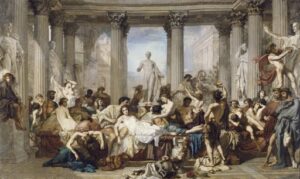
Corinth was a big party town, kind of like Las Vegas, I’ve been told. “What happened in Corinth stays in Corinth.” And apparently a lot happened in Corinth.
A fanciful picture of Corinth.
Sex also is a good gift of God, but misused it also can easily go bad, can enslave. “Whoever lusts for a woman… has already committed adultery in his heart.” Matthew 5:27-28 With the easy access to pornography on the internet, addiction to porn is a big problem these days, and not only for men. If you’re into porn, here definitely is something to give up during Lent, and if you find you cannot, confess it and get help!
The Church has always taught that sexual union outside marriage is wrong. Paul explains here that sexual union creates spiritual union, and therefore “joining yourself to a harlot” was a problem. Judging by what I see on TV and cable and in the movies, it’s apparently acceptable behavior today for “nice” people of both sexes to “join themselves” to any number of other people. That may explain why today many peoples’ souls, their interior lives, seem to be so torn apart. “Flee sexual immorality” for “it is a sin against your own body”. Was Saint Paul just being a prude? No, he was being a theologian and an apt observer of human life.
“Do you not know that your body is the temple of the Holy Spirit who is in you, whom you have from God. You do not belong to yourself. You were bought with a price. Therefore glorify God in your body and in your spirit which are God’s.”
Is that clear enough, you Corinthians? you Christians?
Chanted by Father Apostolos Hill (from Orthodox Chants site)
Gospel for the Second Sunday of Pre-Lent: Luke 15:11-32
“Prodigal” in New Testament Greek is ἀσώτως (asōtōs) – “recklessly wasteful”. The story of the son who demanded his inheritance from his father. Can you imagine anything more insulting? He valued his father’s money more than he valued his father. Then he wasted it on riotous living, and wound up about to eat with the pigs, lest he starve. Here was a young man who deserved no forgiveness.
Get the picture?
This sounds like a simple story. It’s not. Like many of Jesus’ parables, it can be heard at more than one level. There’s a whole lot going on here.
Let’s start at the top and work down.
Third Level: Prodigal Mankind
This parable is the story of mankind’s rebellion and God’s love. Who is the prodigal son who took his inheritance and ran off and wasted it and wound up living in squalor? The prodigal son is Adam.
 “Adam”, I think you know, is a generic name, which means “man, mankind”, all of us. Human beings were created by God our Father to live in a Garden with all good things provided for us, loved by God, loving God, loving each other. We threw it away. We still do, and now we’re living the way we are. Look at the world, Look at us. Look at you. Look at me. God help us all.
But is mankind as a whole about to turn to God in repentance? Apparently no time soon. We’d rather have this than joy in the house of our Father. However, if and when finally we come to our senses and turn back towards God, our loving Father, He will come running out to welcome us, eager to forgive us, and His will can be done on earth as it is in Heaven.
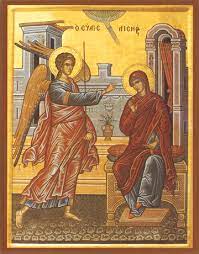
In fact He already has run out to meet us. In Jesus Christ, God our Father has come to earth, eager to forgive us and welcome us home again. “Whoever has seen Me has seen the Father.” John 14:9 “God showed His great love for us by sending Christ to die for us while we were still sinners”. Romans 5:8 Instead of our rags of sin, He will clothe us in the garments of Baptism. His great banquet awaits us in Heaven – of which our first taste is the Holy Eucharist. When we go to Confession, we don’t have to worry whether He’ll forgive us. If we’re repentant, we already know what the priest will say.
However, take careful note: Like the father in the parable, Christ did not go into the pigsty to save us. He did not sin. He is ready to forgive, but He cannot forgive us unless we want to be forgiven, unless we repent and come to Him. God’s forgiveness is free, but it’s not cheap.
Second Level: Early Church History
In this parable, Christ was foretelling what would be happening a few decades later. From the Church’s perspective, the parable would be acted out. There would then be two chief religious groups:
The Gentiles were the Prodigal Son, who had strayed far from God and righteousness, but now were returning to Him, and the Church was welcoming them.
The Elder Brother was the Jews who had long believed in God, been faithful to Him. How did they feel about all these Gentiles turning to their God and being accepted by the Church? They resented it. Why should God throw a “party” for these unworthy, untouchable people – despite the fact that they were now worshiping the God of the Jews! God’s promises to Abraham were finally being fulfilled: “I will surely bless you and make your descendants as numerous as the stars in the sky and as the sand on the seashore.” Genesis 22:17 But the Elder Brother missed the Banquet. They still are. *
- I guess this must be said these days: This is no way justifies any form “anti-Semitism” which is appearing again – along with many other evils which we hoped were gone. Anti-Semitism is wicked and sinful. Read the parable: The Father still loves the Elder Brother. So should we.
First Level: You and Me
This is the literal interpretation, which applies to us individually.
Even that has three aspects: We can play the roles of the prodigal son or the merciful father or (God forbid!) the elder brother.
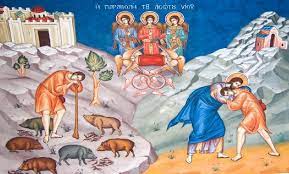
The Prodigal Son. In case you think you haven’t sinned much, all I can say is: You must have mighty low standards. Read Christ’s moral teachings in the Gospels. Hold yourself up against the saints: you and I could have been like them. We have been recklessly wasteful with our inheritance, the good things God has given us. Ask yourself: “How much time and energy have I wasted eating pig food, spending my time on junk or on nothing much? when I could have been with God, surrounded by His love, doing worthwhile fulfilling things, empathizing with people and doing good for them. Do the things that actually make us happy.” Be the prodigal son. Wake up, repent, turn around and go home. Go to Confession.
The Father. Forgiveness Sunday is in two weeks, the day the Church sets aside for us to apologize and forgive before we enter into Lent. We’ll talk about that in two weeks.
Here the father was making a public spectacle of himself in front of all the neighbors. In those days a father who had been offended would sit and wait and then, if the wayward son was abject enough, he might forgive. But here the father runs out to his son, makes it easy for him to apologize, so that before his boy can say a word, he already knows he will be forgiven.
When people have hurt you, be like the father. Make it easy for them to say they’re sorry. Consider this: Why do people often not apologize? Not because they’re not sorry, but because they fear if they say it, they’re going to be turned away, dumped on. Find a way to make it clear that you will forgive. This is often hard, awkward.
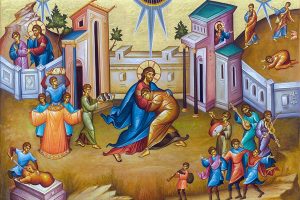
The Elder Brother. Please, please do not play the role of the resentful elder brother. “Well! I have served you faithfully all these years, and here this son of yours has squandered everything, and you kill the fatted calf and throw a party for him! You never threw a party for me, never even killed a goat. It’s not fair!” He was right, of course. His younger brother had been a stupid irresponsible fool, and his father was not being fair.
What does that have to do with anything? If God is fair and just, we’re all in a lot of trouble. What hope is there for any of us? The Kingdom of God is not about fairness and justice. It’s about mercy and love and joy. Jesus said “There will be more rejoicing in heaven over one sinner who repents than over ninety-nine righteous persons who do not need to repent.” Luke 15:6
Here’s the catch in that line: You find me one person who needs no repenting. It certainly wasn’t the elder brother. What did he need to repent of? Lack of love and mercy: If he had truly loved his brother, he too would have been glad he came home. He was also guilty of stupidity: “I’d rather be right than be happy.” He was willfully missing the love and joy which were the true inheritance of his father’s house.
So at the end of the parable: Now who was being recklessly wasteful? Now who was throwing it all away? Now who was the prodigal son?
This is really the parable of The Two Prodigal Sons, isn’t it?
Jesus ended the story there. Did the elder brother give it up and go to the party? or did he stay hard-hearted, stubborn and stupid? What do you think?
But your story hasn’t ended. Before it does: Repent. Forgive. Love. That is the true spirit of Lent and of the Kingdom of God.
chanted by Father Apostolos Hill
“When I disobeyed in ignorance Thy Fatherly glory, I wasted in iniquities the riches that Thou gavest me. Wherefore I cry to Thee with the voice of the prodigal son, saying, “I have sinned before thee. O compassionate Father, receive me repentant and make me as one of Thy hired servants.”
Next Week: Meatfare Sunday: The Last Judgment.
Week after Next: Cheesefare Sunday: Forgiveness Sunday