Well, actually no.
The First Sunday of Pre- Lent (the Sunday of the Publican and the Pharisee) doesn’t come till February 1. However, next Friday, January 30, I want to talk about the Three Hierarchs’ festival which falls on that very day.
So… Today let’s anticipate the Publican and the Pharisee. Then, for the rest of Pre-Lent and Great Lent, I’ll try hard to stick exactly to the liturgical cycle each week. I’ve done this before, but I find it worth going through it again every few years.
Also, things being what they are these days, I’ll probably throw in a few comments about other matters from time to time.
Pre-Lent
Now we get down to work, preparing for Great Lent *which is only a few weeks away. What disciplines should we take on? Which extra Church services should we attend? How should we keep the Fast? However, if we think the purpose of Lent is to darken the church’s doors more frequently and not eat meat for a few weeks, then go back to normal… think again.
- so called to distinguish it from other lesser fasting periods
The purpose of Lent is to take a good look at ourselves and see where our lives are off the mark. Which sins and failings should try to free ourselves from? Which virtues do we need to work on? Should we (finally?) go to Confession? So that by the end of Lent we will love God more, love people more, be on target again – headed towards the eternal Kingdom of Heaven. Our Lenten disciplines are intended to help us towards that End. As someone said, if during Lent we give up meat but not sin, we’d be better off ignoring Lent entirely.
During Pre-Lent:
1 We follow a special schedule of Fasting which looks complex. It isn’t. It’s the Church’s way of easing us into the Great Fast.
2 Sunday Scripture lessons help us prepare.
Pre-Lenten Fasting.
Now listen closely.
First Week of Pre-Lent: That’s the week beginning February 1 this year. No Fasting. Enjoy!

Second Week of Pre-Lent: February 8, 2026. Back to our usual Wednesday and Friday Fast
Third Week of Pre-Lent: Meatfare Sunday: Beginning Monday February 16. Meatfast begins.
Fourth Sunday of Pre-Lent: Cheesefare Sunday: Gather ye fish, wine, cheese and oil while ye may! because…
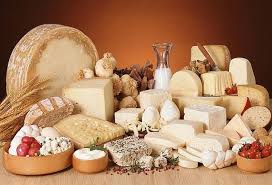
THE GREAT FAST begins on Monday February 23.
See how gently the Church leads us into the Fast. That’s the Orthodox Way in all things.
If you are new to fasting (and with all the people joining the Church these days, many are): Please don’t attempt to keep the full Fast at once. As with all things Orthodox, approach it gradually. This year, if you can manage it, perhaps give up meat for Lent, then next year take another step. We’ll talk more about this later.
Scripture Readings at Sunday Divine Liturgy
Class: Please get out your Bibles, and read the texts.
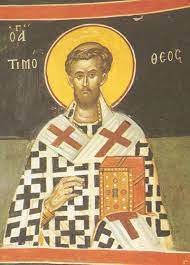 First Sunday Epistle: II Timothy 3:10-15.
Timothy was a protege of Saint Paul, a young Bishop on Cyprus who needed advice from his “father in the Faith”. We are all neophytes in the Faith, no matter our age. Learn from Paul.
Point One
Paul writes: “Timothy, my son, you have observed my conduct, my aim in life, my faith, my patience, my love, my steadfastness, my persecutions, my sufferings.”
Learn from Paul and from all the saints, the heroes and heroines of our Faith. Learn from them to love, to be steady, not to expect an easy life. Paul says Christians will be “persecuted”, .
The Greek word διωχθήσονται, translated here as “persecuted”, means literally “pursued” by troubles – caused either by human beings, or by worse “beings” who pursue us especially during Lent and Holy Week. Did anyone ever tell us following Jesus would be easy?
 In fact this is how life is. We just get our ducks in a row and one flies off. We get things in order over here, and something goes out of order over there. C.S. Lewis said this is God’s way of keeping us from getting too comfortable here, because we’re not going to stay here, and there’s no use trying to pretend we are.
Meanwhile, “evil men and imposters will go from bad to worse, deceiving and being deceived”. Did you ever hear a better description of these present times? It has always been like this – sometimes better, sometimes worse – and will be till the End. So, says Paul (I paraphrase), Don’t get yourself all tied up in knots because of it.
Of course, we need to know what’s happening in the world, be involved in the world. This is the world Christ came to save, and we’re the Church He sent out to assist Him in that project. But as Christ said, we Christians are to be “in the world but not of it”. John 7:14-15 The Church is a “colony of heaven”. Philippians 3:20 We are citizens of a Kingdom which will outlast all the evil in the world – and also the nonsense among Christians, including Orthodox Christians. So don’t be distracted from your business. “Continue in what you have learned and have firmly believed…”
Point Two
”…knowing from whom you have learned it.” Timothy had learned the Faith from his grandmother Lois and his mother Eunice. 2 Timothy 1:5 Already in mid-First Century, Timothy was a third generation Christian!
As we go into Lent I think back to the good Christian people from whom I learned. The Methodist pastors in college who taught me to treasure the teachings of Jesus, including social justice. A kind, humble professor in Methodist seminary who led me to personal belief in and commitment to Christ. Michael Ramsey, Archbishop of Canterbury, whose writings led me deeper into the Faith of the Church. A holy Episcopalian bishop who gave his blessing for me to become Orthodox: “If God is calling you to do this, then you must do it.”
P.S. And how could I possibly have forgotten to mention my mother, who didn’t talk much about her faith, but who quietly lived it out day by day, year by year, sometimes dealing with great adversity. I have never admired anyone more.
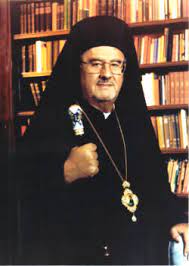
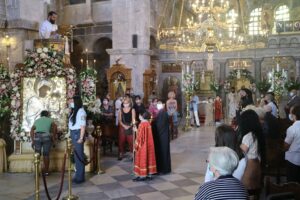
especially all the good Orthodox people: Some Church Fathers who set me straight. The laypeople on the Greek island of Paros whom (though I didn’t understand a word) I watched practicing their Orthodox faith. His Eminence Metropolitan Philip who inspired me. Father Thomas Hopko and Father Peter Gillquist who led me into the Church. And so many more, whom God sent to me at just the right time – certainly not forgetting the intervention of Saint Nicholas and Saint Nektarios, of whom I’ve often written.
And also the people of my parish. I have learned so much from their love, their kindness, their generosity, their good humor, their devotion, their courage in face of adversity. I’ve also learned a lot about being a Christian from my wife. (Don’t tell her I told you that.)
How could I turn my back on them? on what I have “learned and firmly believed, knowing from whom I have learned it”?
So now, it’s your turn: As we head into Lent, think back to all the people who have influenced you for good, taught you how to be an Orthodox Christian. Give thanks for them, pray for them, and “continue in what you have learned and remember from whom you have learned it…”
Point Three:
“…and how from childhood you have been acquainted with the Holy Scriptures which are able to instruct you for salvation in Jesus Christ.” Paul was writing, of course, about the Old Testament. Though he didn’t know it, he was then writing much of the New Testament. And now we have the entire Bible.
 So read it!
We have a great advantage which Christians for fifteen centuries did not have: easy access to the Holy Scriptures. In the old days people had to go to church or to a class to hear the Scriptures read. But we have this inspired treasure house of wisdom and knowledge and “instruction for salvation” at home, and now online, just waiting for us.
The daily Orthodox Church lectionary takes us through the Gospels twice a year, the Epistles once a year. During Lent we read the Old Testament: Genesis, Proverbs, Isaiah.
- For the appointed readings for each day, I go to: www,antiochian.org.litugicday or to https://www.goarch.org/chapel/ The Greeks will even email them to us every morning! Or if you choose to read at your own pace, that’s fine.
What’s most important is that we read the Scriptures, especially the Gospels and get to know our Lord Jesus better – His saving acts, His teachings, His wisdom, His personality – this most compelling, most fascinating Person in human history, He who is the Alpha and the Omega, the key to everything.
Don’t worry if you sometimes find it difficult to understand Him. Jesus was very mysterious sometimes. Even His Disciples sometimes found it hard to figure Him out. If you read about Him regularly, things slowly become clearer, but after sixty-plus years reading the Gospels almost daily, I still often have “Ah ha!” moments. Just keep reading.
Brothers and sisters, I sometimes wonder if perhaps part of the Last Judgment might go like this. Our Lord Jesus Christ will say “Tell me about your priorities in life. Tell me what you know about sports… about entertainment… music… politics… Now, tell me how much you know about Me.” Will He then have to ask: “Why did you not take just a few minutes a day to get to know Me? Did you not ‘love Me more than these’?” God forbid.
First Sunday Gospel: Luke 18:10-14: The Publican and the Pharisee
A Publican was a “tax collector” – not, as I thought when I was a boy, a guy who ran a “pub”.
Why did God reject the prayer of the Pharisee?
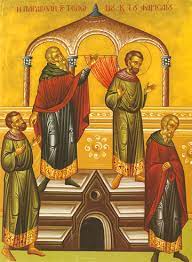 Look at the icon. He certainly appears to be doing it right. However, for one thing, the Pharisee wasn’t talking to God. Note: “He prayed thus with himself”. Fake prayer. Meanwhile, though the Publican didn’t appear to be praying, he actually was: “God, be merciful to me, a sinner.” Keep this in mind when you’re in church.
However, the big problem was the content of what the Pharisee was saying. “Lord, I thank You that I am better than other people – like this revolting person standing here beside me in church.” (I paraphrase.)
God hates pride and honors humility.
We hear this again and again in the Scriptures. “Pride goes before a fall.” Proverbs 16:18 Read the Bible regularly and that will begin to sink into us. The Virgin Mary summed it up during her visit to her cousin Elizabeth, in a song which we chant at Matins almost every day: “My soul magnifies the Lord… He has scattered the proud in the conceit of their heart… He has put down the mighty from their thrones and has exalted the humble.” Luke 1:46-55
Today humility is out of style, at least in our culture. “I’m the greatest. I’m a winner. You’re a moron. You’re a loser.” Apparently talking like that is now acceptable behavior – if not around the neighborhood (yet), then in politics and political commentary, and on Facebook and Twitter (whatever they’re called now – I don’t pay much attention) and the like. And you know it comes from the top down.
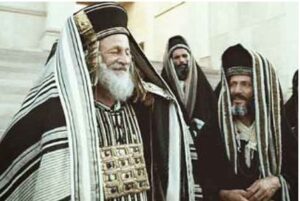
Now, was the Pharisee objectively a better man than the Publican? Yes! Of course it’s better to fast and tithe and be faithful than it is to cheat and steal and commit adultery. That is Christ’s point here. Pharisees were the best religious people. They kept the Old Testament Law scrupulously and then some.
Tax collectors were traitors (collecting for the Roman occupiers), bullies, cheats – and greedy, enriching themselves to the detriment of the poor. Think of today’s billionaires and now trillionaires,, forever gathering more money to themselves, while people go without food and basic health care.
So why did the good proud Pharisee offend God? why did the sinful Publican please him? Because pride is a dead end, while humility at least allows for the possibility of improvement.
Look at it this way: On a scale of 1 to 10, 10 being moral perfection, say the Publican was a 2, and the Pharisee was maybe a 3 or 4. (We all have a long way to grow.) So long as we focus on people who are worse than us (or at least we think they are – there’s much we don’t know), so long as we don’t set our sights higher, we’re never going to get any better.
In fact the Pharisee may well get pulled down to a 2, before it’s all over. I mean, Hitler could look down on Stalin and say “I killed only 6 million people; he killed 10 million. At least I’m not as bad as him. So maybe it wouldn’t be so bad if I kill a couple million more?” Or in our case, we look at the bad behavior of others and think “Well, everybody does it. It wouldn’t be that bad if I did it, too.” And down we slip from a 3 to a 2.
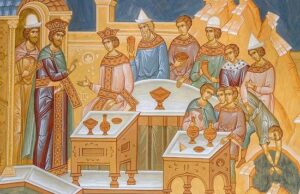
Pride is the worst of sins because it kills moral growth, and eventually kills the soul. Unless by God’s grace we finally become a 10 *, we’ll get to the heavenly banquet, and the King will say to us, “Friend, how did get here not dressed for the wedding? Out you go!” Matthew 22:11-14
- Something which we won’t attain till well after we die.
Three more things:
1 There is such a thing as false humility: “Lord, I’m no good. I’m a worm. I never do anything right.” That’s not humility. That’s neurosis. We’re all created in the image of God. There’s good in the worst of us. True humility means just being honest about ourselves. The fact is we all have a lot to be humble about.
2 There is such a thing a proper “pride”. It’s right to be proud of doing a good job at our work, or at our children’s accomplishments, for example – so long as we remember that all good things are ultimately gifts of God. The dangerous kind of pride consists of taking credit for it myself, as if I were the source of it all.
3 Beware lest you become proud of your humility. That’s the devil’s clever trap. I never saw a more devious case than this: A few years ago a prominent politician * was accused of being prideful. Indeed he often brags about how great he is. In response he bragged: “I’m really a very humble person.
- Want to guess who?
So here’s one thing to work on during Lent. (You may even start now.)
If you have fallen into the habit of looking down on others, people whom you think are worse than yourself, STOP! Even if they’re utterly despicable, total rats, STOP! In order to accomplish this, you may need to stop watching news 24 hours a day during Lent and stay away from social media and the like. “Lead us not into temptation.”
Every time you’re tempted, quickly say the Prayer of the Publican: “God, have mercy on me, a sinner.” Your job is to think about your sins and your failings. My job is to think about my sins and failings.
Set your sights high. Compare yourself to the saints. Compare yourself to our Lord Jesus Christ, who is a “10”. God is calling us finally to become like Him, the sinless One. 1 John 3:10
To read about the saints for each day, try:
https://www.oca.org/saints/lives
https://www.mystagogyresourcecenter.com
John Sanidopoulos (at the Mystagogy Resource Center) has the most remarkable collection of lives of the saints I have ever come across. Please note that he is in need of donations to help continue his work..
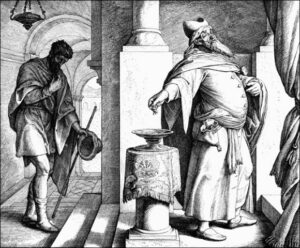 Finally, have you ever noticed where the words of the most popular Orthodox prayer came from?
Not from the good Pharisee. Try to imagine repeating over and over on a prayer rope: “Lord Jesus Christ, Son of God, thank You that I am not a sinner like other people”!
We pray the words of the sinful Publican. “Lord Jesus Christ, Son of God, have mercy on me, a sinner.”
Next Week: 1 – The Three Hierarchs: The Greek Festival of Learning
Week after Next: The Prodigal Son, 2 – Some Advice about Fasting from Saint Paul
Wow!
Lots of rich material here, Father – many thanks!
I love the way you list the people who taught you the Faith and encouraged you …