This has been a long vacation, folks. I see from the Blog stats that some have headed home already. * Understandable. However, I think you who are still hanging in here will enjoy our last week in Greece.
- We bloggers know these things. But relax. We don’t know your names.
Today we’re…
Back to the Mainland and Saint Nektarios
We wanted to visit Saint Nektarios again, so on Wednesday September 28 we flew into Athens. Ever since that first remarkable visit to him in 2002, and the “coincidences” that followed (some absolutely startling) Nektarios has been my travel guide. He always seems to come through. On my Greek trips I kept thanking him for every “coincidence”, feeling sure he was at it again. *
- If we have any new non-Orthodox readers, please understand: Of course God is the source of all good things. Sometimes he helps us directly, sometimes he works through people on earth, sometimes through saints in Heaven – who don’t always seem to stay there, do they?
Anyway, here’s this year’s example of how our travel seemingly-inexplicably works out: The day we arrived back in Athens all transit workers were on strike: no taxis, no buses, no light rail, no metro, no trains, no everything. I had not checked the news, and learned about the disruption as we sat in Heraklion airport about to board our plane for Athens. We had reservations, so we figured we might as well go ahead and take our chances.
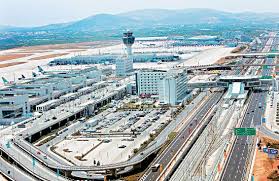
Athens αεροδρόμιο, by the way, is the best designed and most efficient airport I know. I was so impressed by the Greeks – till I later learned it was designed by Germans!
When we arrived, everything was tied up. Nothing was moving. People were stranded. Our hotel was maybe 20 miles away. What ever were we to do? “Saint Nektarios, help!” I called the hotel to see if they could imagine any way to get there. Yes, certainly, the clerk said. We have our own shuttle service! Very few small independent hotels do so, but ours did, and soon we were safely settled in our room. Another “coincidence”? or did he do it again? Just in case, thank you, Saint Nektarios!
Vespers at Saint Alexandros Church
That evening we went walking and stopped at the beautiful Saint 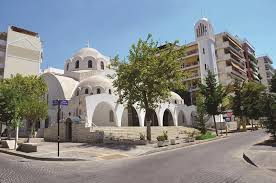 Alexandros Church around the corner from our hotel. (As I told you, in Greece there’s almost always an Orthodox church around the corner.) There they had a small Saint Nektarios chapel with an outside entrance. You can see it to the left. But the church itself was open, and as we walked in we heard the sound of people in a chapel to the right, almost belting out Phos Hilaron, “O Gladsome Light”. Greeks singing aloud in church! people participating verbally! And Vespers on a weeknight! We went in.
The chapel was full. People smiled and got chairs for us. It was very informal as is common in Greece: one chanter was holding a baby who yowled from time to time till his mother came and got him, and then people fussed and smiled over the kid as he quieted down – all as Vespers continued. It was very homey and very holy at the same time in the usual Orthodox way.
Out to Aegina and Saint Nektarios
Next day, Thursday, was our day to visit Saint Nektarios. Was it by chance that all public transit was now operating? and it was a gorgeous blue day with no Athens nephos/smog. Explain it as you will, I said thank you again to Saint Nektarios.

We hopped onto the tram (light rail), then changed to the metro to get to the port, and took the ferryboat to Aegina (pronounced EGGena, with a soft “g” in the back of your throat), the island of Saint Nektarios. In front of us on the back deck of the boat was a nice looking young couple who hugged and kissed and carried on something fierce all the way to Aegina. I said to Dianna that maybe they should have booked a room! – though they were actually kind of cute. When we got to Saint Nektarios, who was right ahead of us in line lighting candles? It was the love birds! Maybe they were newly married and praying for a baby? If so, as I told Dianna, judging by what we saw on the ferryboat, I thought chances were pretty good.
The visit to Saint Nektarios was lovely as always. We lit candles and prayed for all at Saint Nicholas, Cedarburg, and all the people whose names they had given me – over 1000 this time. I was moved again by the love and devotion of our congregation. The little widow * who guards the shrine where his skull is kept scowled at us as usual till I handed her the 250 euros which our people had given me, as well as the list of names, and then as always she broke into a big grin and told me (in English, kind of) that the nuns would pray for them “avrio”, tomorrow – and she gave me some Saint Nektarios oil and pictures.
 You can tell because in Greece widows traditionally wear black. However… I was once on the beach by myself reading, dressed as one does for the beach, when this widow came along and set up her towel, and I wondered should I cover up? – till she whipped off her black dress, revealing a tiny red bikini, and dived into the sea!
A busload of pilgrims arrived, so we moved over to the quieter chapel where Saint Nektarios’ body lies. * I put my ear to his tomb. Some say they can hear him knocking but I never have. Dianna and I read the Paraklisis Service to Saint Nektarios, offering it up for all our people at home. There’s something very fulfilling, just right and good about doing that.
- Why ever is it common to separate the relics of a saint’s skull from the relics of his body? I don’t understand these things. But not so many years ago I wouldn’t have understood relics at all.
Sorry, there was no major Saint Nektarios “miracle” this time, none of his 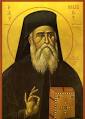 usual tricks. I’ve told you the stories. (Newcomers, read back. I listed them in a Post a few weeks ago.) I guessed he gave me those at the beginning just to get my attention. Well, by 2011 he’d got it! I think there’s not a day when I don’t talk to him, pray to him. His icon has a special corner at Saint Nicholas Church, where people pray and light candles and leave flowers. He hangs in our icon corner at home (he’s looking at me as I write this), and another icon sits beside my bed where I tell him good night, and when I travel he travels with me in my suitcase. And there I was visiting him on Aegina for what? the sixth or seventh time? He doesn’t need to do tricks so I notice him anymore. I was later to discover he had another very important purpose.
Pagan Temples
By the way, if you ever get to Saint Nektarios monastery, try to go also a couple or three miles east on the north coast (you can rent a cheap car, or a taxi can take you there) to the ruins of the Temple of the goddess Aphaia (APHea) – 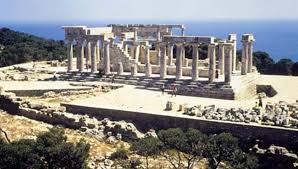 on a lonely hill looking across the sea towards Athens. The tall white columns still stand, though the roof is long gone. A kind of stillness hangs over the place, even when tourists are there. I’m not trying to encourage paganism! but certain places have this “aura” about them – almost require a person to worship somebody – and this is one of them. The only problem with the pagans was that they were worshiping the wrong persons, instead of the Right Persons.
In 1985 I climbed up to the Acropolis at dawn 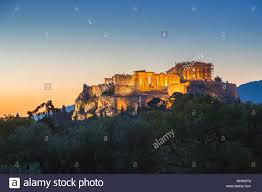 almost all by myself, as one could in those days. It felt similarly holy, a place where worship was needed – and that was before I knew that the Parthenon for almost eight centuries had been a Christian church dedicated to the Theotokos. Here too the pagans had almost got it right: they had just been praying to the wrong virgin (Athena) instead of the Right Virgin. I presume you know that after the Turks took it over, having no virgin to pray to, they used it for a munitions depot, and that’s how part of it got blown up. Despicable.
Back to the trip: Next day we flew out and missed connections in Frankfurt by ten minutes just like the previous year, but Lufthansa put us up very nicely for the night. One day late we were jet-lagged but home.
Reflections on re-entering
I returned home after our 2011 trip with, as always, mixed feelings – happy to be home and see my family and my people at church whom I love so much, and the kindly people of Wisconsin.
There’s so much I love dearly about America and Wisconsin. It’s where I belong. But after a little while in Europe it was always hard to come back and see what has happened to America: how divided we are, how dysfunctional American government had become, how peculiar American religion had become, how far behind we were falling in so many ways. In Europe I found little crime and almost no gun violence, safe cities and schools, and transportation like we used to have – buses and trains connecting every little village. When I was a boy we lived in a small village. I’d hear the Greyhound bus stop in front of of our house, and Mom would say “Grandma’s here!” Today Grandma wouldn’t be able to come to visit.
And that was fifteen years ago. I never could have imagined what things would be like today.
I won’t go on, lest I get preachy as preachers tend to do. But I’m old, and I can remember when America was not like this, and it makes me very sad.
How to get past my dismay on returning home? Three possibilities:
1 Forget it. Probably I’m just become old and cranky. After all, my parents handled World War I, the Great Depression and World War II – and I should complain?
2 On that 2011 trip I read a book Our Thoughts Determine our Lives by the 20th century Elder Thaddaeus of Serbia – well worth reading, available like everything else in the cosmos from Amazon and Thrift Books and 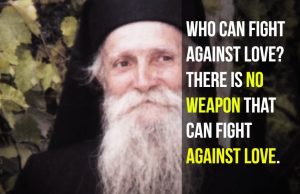 other sources. In his life Thaddaeus had suffered through Nazis, Communists and many personal and family problems. He advises, in essence: “Don’t let the, uh…[ ] get you down.” He says that if we become angry or negative we can’t solve the problems; we then ourselves become part of the problem. Without ceasing to do our work, we have to learn to commend all things to God in faith and then live positively. I guess this is a holy version of the old song “Accentuate the Positive”. Even though what’s in the news and online these days is genuinely depressing, there remains so much positive in the world. So turn off the TV and put down your smartphone and computer (after you read this Blog, of course!) and see all the goodness around you, and move ahead.
3 And then never forget this: There is one thing in this world that is solid and dependable. Jesus Christ and His Church have survived 2000 years, through every culture, every kind of government, every war, every economic downturn, every persecution, every deprivation, every stupidity, every evil, every everything. God knows the Church also has her vicissitudes, her failings. I’ve told you this: Father Alexander Schmemann, then Dean of Saint Vladimir’s Seminary, after a day spent dealing with particularly trying people, was heard muttering, “The Orthodox Church is the right Church filled with all the wrong people!” Well, the whole world is filled with the “wrong people”, us. But that hasn’t stopped God and his holy Church.
“Two Homes”

At the beginning of this series, I told you that over the years Greece came to feel like a second home to me. I can’t explain it. My people always said I came back from Greece rejuvenated.
I love so many things about both places. I love America’s friendly kindly people and our democratic government and multi-culturalism (both under attack now) which allowed my forefathers and foremothers to come here, and me to be here in Wisconsin writing this. But I also love Greece’s cultural unity centered around Orthodoxy. And so much more about both places.
So when I was in Greece I was always homesick for home, and when I was home I’d be homesick for Greece. That hasn’t changed after all these years. I know I’ll never get back to Greece again. Writing about it makes it better. And worse.
I guess I feel a little of what immigrants to America must have felt in the old days – my great grandparents who knew they would never see their old country and family again. Never. Not ever.
How to hold all this together?
Have you read the last book of C.S. Lewis’ Chronicles of Narnia? where the English children have arrived in “Aslan’s Country”, which is Heaven. And as they move ever further up and further into this Country so new to them, they are amazed to see that somehow they are also in their homeland of Narnia again, a renewed Narnia – and that afar off England, a renewed England, is also there, and they are all moving together further up and further into “Aslan’s Country”.. (It’s hard to describe. You need to read the book.)
And one of the children says:

I hope that when, God willing, I get to the Kingdom of Heaven, I will discover that America is also there, restored to its true beauty and made new, and Wisconsin and Greece and all I have loved. I hope it will be so for you, too.
For all good things are to be saved and redeemed and renewed. In our True Home, we will find the answer to all our longings for home.
Next Week: Is Orthodoxy conservative or liberal?
Week after Next: Well… uh… I’ll come up with something.
Thank you Fr Bill! Your blog is always uplifting and genuine in its content. I appreciate your insight and observations of our society’s ills and possibilities.
Peace be with you!
in ICXC
Fr. Basil Gikas
Wyckoff NJ
And peace be with you, Father Bill.