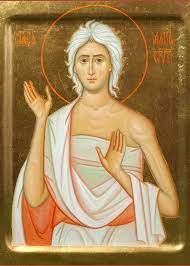
This story has always captivated me, for reasons I can’t explain.
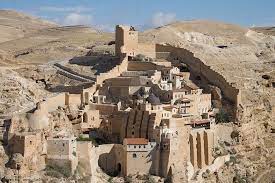
The Monastery of Saint Savas (Mar Sabas) in the Palestinian West Bank down below Jerusalem is one of the oldest continually functioning monasteries in the world.
In the late Fourth Century monks from Mar Sabas spent much of Lent alone in the desert. A priest-monk Zosimas, walking alone one day on the Jordanian side of the river, to his surprise saw someone ahead of him. He called out and a woman answered: Don’t come close – I’m not decently dressed. She was in rags, barely covered. Zosimas left his cloak and drew back. She covered herself, then he came near. She said: You are the first person I have spoken to in 47 years. And she told him her story.
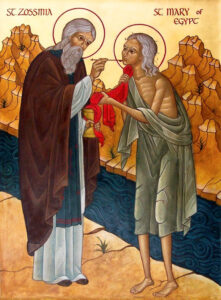
Her name was Mary. In her teens in Alexandria, Egypt, she had become a prostitute of the most dissolute sort and had been so for seventeen years, which had gained her great notoriety and financial luxury. She had gone to Jerusalem – on “business”? The empire was now Christian. Jerusalem was drawing many pilgrims, and Mary was swept up in a crowd going into the new Anastasis, the Church of the Resurrection, to venerate the Holy Cross. Did it just happen? or was she seeking? perhaps she didn’t know. Anyway when she reached the door she could not go in – it was like a physical barrier.
And she understood: she was unworthy to enter. Suddenly what she was, her sinfulness. swept over her like a wave. She found herself kneeling in the street before an icon of the Theotokos pouring out her shame, promising to repent, to change. Then she went back to the church as a new woman and went in.
Soon she left the city. The temptations there were too much. We all know that we can repent of sin very sincerely and yet the temptation comes back. Old habits are not easily broken. So Mary fled across the River into the Jordanian desert and had lived alone all those years. There she had found God and inner peace.
She wanted to remain alone, so she swore Zosimas to secrecy, but asked him to return next Lent and bring her Holy Communion. He did so. As he drew near the Jordan, she approached the far bank and walked across upon the waters.
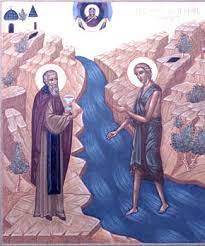
She asked him to return the following year. This time she was not waiting. He found her body in a hut with a note: “Abba Zosimas, please bury the remains of humble Mary. I died the day I received Communion. Pray for me.” Before he could begin, a lion came out of the desert and began to dig her grave. She was apparently one of the many saints who have made friends of wild animals.
Zosimas went back to the monastery amazed, but now able to tell her story. Sophronios, Patriarch of Jerusalem, was so moved by it that he had it written down. It spread widely among the faithful. And that is how we have come to hear about her today.
Two Lessons from Saint Mary of Egypt
1) Repent
“I repent” in New Testament Greek is “metanoeō / μετανοέω”. It does not mean to feel bad about our sins and failings. It does not mean to grovel before God: “Lord, have mercy” 500 times. It means to do something about them: “turn around”. Turn away from evil.
The best way to repent is to make use of the sacrament of Repentance (Confession). Confess, be assured of God’s forgiveness, get some counsel about how to be rid of your sins, and quickly get on with life. (We’ll say more about Confession in a minute.)
We need to repent not only of the things of which we feel guilty, “culpable sins”, but also of our failings. You know that “sin” in New Testament terms means simply “missing the mark” (ἁμαρτία/amartia). It’s an archery term. The bullseye is to “love God with all our heart and soul and mind and strength, and our neighbors as ourselves”. Most sins are not culpable; they’re habitual – such as complaining, judging other people, putting ourselves down, failure to pray. For whatever reason we’ve just fallen into them and often scarcely notice them, but from which we need to be rescued.
Repentance is a positive thing, turning away from darkness towards the light, from misery and pain towards God and joy. We all know that sin doesn’t make us happy, at least not for long. Sin is poison; it finally destroys us, makes our souls go dead.
The Church places Saint Mary of Egypt today, two Sundays before Pascha, because there is no better example of repentance, and we need to repent, lay our sins down and draw near to God, if we are to have a truly joyful Pascha. Here was a woman who came to know her sin and really cleaned up her act. She reminds us that all sins can be forgiven. Remember, however, that bodily sins, though the most notorious, are in many ways the least dangerous. It’s the hidden “spiritual” sins – pride, anger, jealousy – that are often the most life-threatening.
The second lesson from Saint Mary of Egypt:
2) Flee to the Desert!

Mary gives us an extreme and memorable example of how to escape from temptation. However, fleeing alone is dangerous for most people; most people. If they do that they go mad. Mary was so habitually addicted to sex and the pleasure and money and high life style it gave her that she had to get away from society altogether. We should flee to the Church – in many ways a place apart from this fallen world – where we will be supported in good behavior.
However, we also, as best we can, must get ourselves out of situations where we’ll be tempted. For example, if addiction to alcohol is your big problem, stay away from bars and pubs. If you’ll necessarily be present at places where liquor is served, plan ahead how you’ll handle it: get yourself a soda and sip on it, or say “no thank you” if you can manage it, or say the Jesus Prayer, or go home if you must. If lust or addiction to computer shopping are your issues, shut off the computer or smart phone and keep them off, except on necessary business. Or get rid of them. I know people who have blocked sites or gone back to a simple phone, for just that reason.
I’m not saying this is easy. But if we do not plan ahead for these situations, it means we’re not really serious about repenting, about escaping from our sins and getting ourselves back “on the mark” again.
The Sacrament of Repentance: the “Mystery” of Holy Confession
The best way to flee into the desert and keep ourselves there – to begin and continue the process of repentance – is to make regular use of this blessed “Mystery” given to the Apostles by Christ Himself on Pascha night: “Whoever’s sins you forgive are forgiven; whoever’s sins you retain are retained.” John 20:23
God so loves the world, loves you and me so much, that He doesn’t want us to throw our life away on trash and finally wind up with nothing – because we can’t take our sins into Heaven. “Nothing unclean can enter there.” Revelation 21:7 If we plan to hang onto our sins, we’re going to have to take them somewhere else.
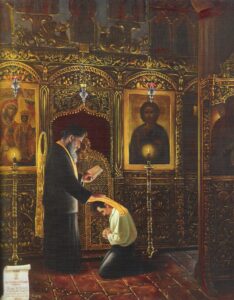
If you’re not accustomed to making your Confession, how should you approach it? (I’ll not deal with the “mechanics”, since they differ a bit from parish to parish. Please check with your priest about this.)
First, open your heart to God and look honestly at your life. You should confess whatever’s troubling you most, but you should also check for other sins. This is like listing our physical symptoms before we go to the medical doctor. (Even if you’re not going to make a formal confession, this is a good thing to do.) If you need help in “examining your conscience”, look online or in many Orthodox prayer books where you can find questions to help you do so.
If you have not made a Confession before, should you be scared or afraid that the priest will light into you? No. Of course not. No more than a medical doctor does when you tell him you’re not feeling well.
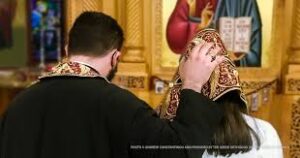
I like one line from our Antiochian Orthodox form: “Then the priest says in a kindly voice: My brother (sister) inasmuch as you have come to God and to me, be not ashamed.” Kindly. The priest is not there to beat you over the head and make you feel ashamed. He is there only as a witness to hear you out, and as a spiritual doctor, to help you, to assure you of God’s forgiveness and let Him heal you.
Please understand that what the penitent says is “under the seal”. The priest is morally obligated to tell no one what you said. * If he violates that trust the Bishop will likely come and kick him out the front door. Orthodox priests in Communist countries went to prison, even the Gulag, rather than tell the authorities what they heard in Confessions.
- Someone once asked me, seriously, “Do you tell your wife what you hear?” Of course not! I can’t do that!
The priest will usually give advice based on the Church’s 2000 years of experience dealing with sinners, and on his own experience hearing Confessions, and also on his experience dealing with his own sins.
Confession has at least five very positive effects:
1 When we confess our sins and say “forgive me”, then someone answers us. Someone with authority from Christ through the Church responds: “God forgives you”.
2 It helps us deal with guilt, so we will not be pre-occupied with it and can get on to living positively.

3 It provides a regular spiritual checkup, like going to the doctor or dentist regularly. I hope we care about our souls as much as we do our bodies.
4 Sin never seems so stupid as when we say it aloud. Things that were so tempting: I think to myself “I found that interesting? Really?”
5 As I said, Confession gives a specific time of repentance, turning around. I’m not allowed to tell you about anybody else’s confessions, but I can tell you about one of my own. Once when I worked in an office I got involved in what began as conversation about someone, then turned into malicious gossip that was doing real harm to that person. It was so interesting that is was hard to stay out of it. So on Saturday I went to Confession. That provided a real stopping point for me. I felt clean again.

When I went back to work on Monday, and the gossip started again, I found it easy to keep out of it. Why? Well, wash your car, and you will not want to drive through the mud again.
Those of us who go to Confession find it helpful, healing, consoling, strengthening, sweet. It’s a shame to miss it.
How often should people go to Confession? Some go often, some before the great Feasts, others when they feel the need. There’s no official rule, at least in my Antiochian Archdiocse.
Now, in case any of you wonder, two footnotes about hearing Confessions:
1 Does the priest think worse of you because you come to Confession? No, of course not. The priest already knows you’re a sinner. Everybody knows that! You think it’s a secret? The priest thinks better of you for being brave and coming to Confession.
2 Does the priest get a kick out of hearing peoples’ sins? The answer is: No way. Hearing Confessions is boring. There are only seven deadly sins. I hear the same things over and over again, with some permutations on the theme. I confess the same things over and over again. If you want to entertain the priest, invite him to dinner. If you want to bore him to death, come to Confession.
I wish we all could just stop sinning, but we can’t we seem to do that. Therefore, if it will help you to repent and keep trying to hit the mark, for your sake your priest is prepared to be bored.
Now, just a few words about:
This Sunday’s Scripture readings
…which please read for yourself. Both are placed here to lead us on towards Holy Week, which is only a week away now.
The Epistle: Hebrews 9:11-14 speaks again of Christ entering into the true Holy Place beyond the curtain of death. His Sacrifice created perfect unity forever between God and mankind.
Do you want circumstantial evidence? Up till the time of Christ, there were many great sacrificial religions in the world, How many remain today? They have faded away, as if somehow they sense they have no function anymore. The perfect Sacrifice has now been offered.
Holy Gospel: Mark 10:32-45
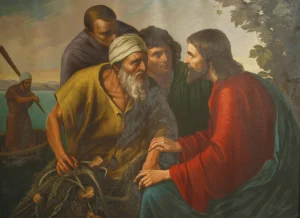
The Lord tells the Twelve that now we are going up to Jerusalem. They could handle that. They are sure Jesus will now come into His Glory, restore the Jewish nation and reign from Jerusalem. Perhaps some believe He will establish the Kingdom of God on earth. James and John wanted to be second and third in command.
Though He had told them at least three times now, they could not take in that He goes there to be killed, then after three days rise – He must be speaking in symbols, as He so often does.
When the other Apostles heard what James and John had been up to, they were indignant. They wanted to be first. So Jesus tells them the key to true leadership – utterly reversing how most people in power see it. “You know that those who are supposed to rule over the Gentiles lord it over them, and their great men exercise authority over them. But it shall not be so among you; but whoever would be great among you must be your servant, and whoever would be first among you must be servant of all.”
After World War II, for a while, some of the world’s leaders and authorities seemed to have learned the lesson. Bullying each other had killed at least 200 million innocent people. Was it time to try to get along and instead do things to help people, to serve them? But generations pass, and people forget the lessons of the past. (I know. I’m old. I’m watching it happen.) The world is rapidly re-arming again. Many rulers and leaders, instead of serving people, are again lording it over them, bullying and trying to dominate – often in the name of the Jesus Christ and Christianity and the Church. I’m no politician. What do I know? Only that this was not what Jesus commanded Christian authorities to do. That’s not how Jesus did it.
“For the Son of man also came not to be served but to serve, and to give His life as a ransom for many.”
That last line deserves a comment, because it has been misinterpreted by many Christians. To whom did Jesus “pay the ransom”? Some say it was a sort of payment in suffering, required by God the Father, which allowed Him to forgive mankind. That was a medieval misinterpretation in Western Christianity, which led to their over-emphasis on the sufferings of Christ on the Cross and misunderstanding of the meaning of the Cross. That is not Scriptural. It was not how the Fathers or the Orthodox Church see it. “God is love”. The Father doesn’t work in such an unloving way.
Look: Ransoms are paid not to the authorities but to the “bad guys”. Listen to the Divine Liturgy of Saint Basil: “He gave Himself as a ransom to death”. In exchange for His death, Satan was forced to release the dead whom he held captive in Sheol, in Hades. And then…!
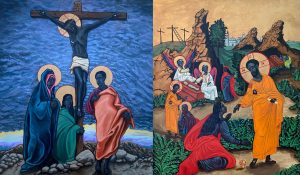
Next week the Church again leads us through that glorious Story.
Beginning next Friday: the first of our annual twice-daily Posts on the Services of Holy Week