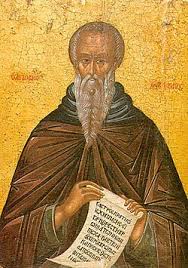
The theme for this Fourth Sunday of Lent is Saint John Climacos (of “the Ladder”) so called because of his book The Ladder of Divine Ascent, one of the most popular books in the ancient world. More about him in a bit.
A Wandering Introduction to the Ladder of Saint John Climacos
Two stories:
1 Last Sunday at coffee hour two people, new to Saint Nicholas, told me that their former denomination has a dramatic performance in which the great Judgment comes, and those who recite the formula, “I believe in Jesus Christ as my Lord and Savior”, are taken by angels off to the right into the Light, and those who do not are taken off to the left into the glaring red lights of hell, and door is slammed shut – leaving the children terrified, and perhaps some of the adults, too.
I was so “gob-smacked”, horrified, * that I without thinking made a loud and unmannerly “PFFFFFT” * and said, “But God isn’t like that”.
- not formal theological terms
2 Probably I’ve told you this story before. Many years ago, a man from a “Bible church” came to visit me, curious about Orthodoxy. He told me how they “saved” people in his church. He said they asked “Do you want to be sure you’re going to Heaven?” Well, who wouldn’t? so people often said “Yes”. “Then say these words: ‘I believe in Jesus Christ as my Lord and Savior’, and you’re assured of going to Heaven.” He then asked: “How do you Orthodox do it?” I think this was the first time I’d run into this approach, and I found it so startlingly un-Biblical that I was taken aback, and all I could get out was: “We Orthodox don’t do it that way.” By the way, the man has been Orthodox for many years now. I’m pretty sure it was not my brilliant response that converted him!
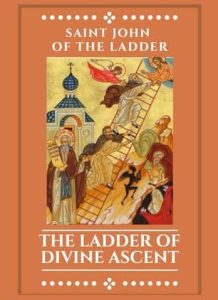
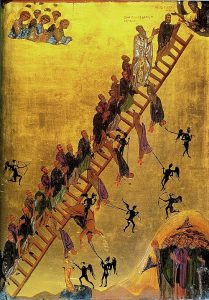
Which brings us to Saint John Climacos (of “The Ladder”) and his famous book, The Ladder of Divine Ascent, which contains thirty chapters, each of which represents a successive step, a virtue by which we can make the climb to Heaven.
This is the Orthodox, Scriptural and Patristic understanding. We don’t go to Heaven by “getting saved” or simply having what some call a “born again” * experience or by giving our lives to Jesus. Not to denigrate those things. For some people they’re the beginning of the process – only the beginning.
- According to the Scriptures (John 3:5, for example) we are actually born again “of water and the Spirit” in Holy Baptism. However, using their definition of “born again”, I think I’ve been born again at least twice by now, and I’m looking for another big one before too many years.
Then we need to work so we can grow, ascend in virtue, step by step, so we’ll fit in when we get There. Remember the parable of the wedding feast (Matthew 22:1-14): The Master throws a wedding banquet. Then this guy comes in “not wearing a wedding garment”, and the Master has him thrown out. That could be us. It’s like one of our bad dreams. We wind up in this elegant place, everybody dressed fit to kill, and we’re in shorts and a tanktop, all dirty – we’ve been gardening or something. It would be like that if we got to Heaven this afternoon the way we are now. We’d all scream “No, let me out of here! I don’t belong with all these holy people. Let me get cleaned up first.” First we need to climb The Ladder of Divine Ascent.
This is the Orthodox understanding of how we are “saved”. We’ve got to work at it. The theological term for this is “Synergeia” (συνεργία). It means “cooperation”. It’s like growing a garden. God provides the soil, the seeds, the sun and the rain. However if we just sit there and watch, we’ll get no harvest. We must cooperate with Him: plant, water, weed, and keep it up till harvest time. So “Work out your salvation with fear and trembling.”
How do we work to become holy, to get us to the Heavenly Banquet? God has provided all we need to get us there: The Holy Scriptures and the Creed and the teachings of the Fathers to guide us, the Holy Eucharist to strengthen us, the Church community to encourage and support us. We’ll also need to do a good bit of weeding, using the sacrament of Confession. And much more. Then be patient. Gardens don’t grow overnight. In the Orthodox understanding, if we are faithful and get a good start here, God will give us time “on the other side” to grow to fruition. (He’d better. I’m 87 now, and my garden still has weeds in it, and a long way to grow.)
But if we expect God to do all the work and pull us up to the top of the stairs: Good luck, brothers and sisters, it ain’t gonna happen. “Many who are first will be last, and the last first.”
The Life of Saint John of the Ladder
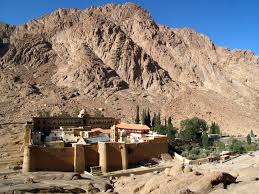
An interesting character: born in Palestine in 579, at about age 16 he went to Saint Catherine’s Monastery, isolated at the foot of Mount Sinai where Moses had received the 10 Commandments. (It’s still a functioning monastery.) John got a blessing to be a hermit, but not like you think: He was forever having visitors. He loved to talk and tell stories, till he was accused of being a chatter-box, so he kept total silence for a year to prove he could do it! He was called back to the monastery to be abbot and wrote his book for his monks. He died there in 649.
Regarding The Ladder of Divine Ascent, a warning: The book contains much of value, but it was written for monastics, and some of what it contains does not apply directly to people who live out here in “the world”. In one chapter (which I can’t locate at the moment, and I’m trying to get this Post published only a day late) John writes positively about a monastery he visited, where they had the most extreme (I would say “unhealthy”) asceticism. Please do not try to imitate that. I think you can figure all this out for yourself, but if you have any questions, just ask your priest or any experienced Orthodox Christian.
Back to the ladder: just one more thing. If you climb a ladder and get halfway up and decide to stop or if you fall off, you’d have been better off if you’d never started climbing. Here’s the icon for the day. Take note.
Scripture Readings for the Fourth Sunday of Lent.
Holy Week is near now, and our readings prepare the scene.
Epistle: Hebrews 6:13-20
After decades of hearing this reading, I still have no idea what the first part of this Epistle is all about, or how it applies to today. I think the Fathers chose it for the last line: “We have…a hope that enters into the inner shrine behind the curtain, where Jesus has gone as a forerunner on our behalf”.
Once a year Jewish priest went behind a curtain into the holy of holies of the temple. Jesus has gone behind the curtain of death into the true Holy of Holies to prepare a place for us.
Jesus who leads us through life has also led our way into death, through death, so even though we can’t see what is there on the other side of the curtain we will not be afraid, for we know He is there, and where He is there is not death but life. That is our hope. For Jesus our Lord and God and Savior “is good and loves mankind”.
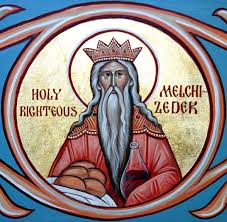
Christ is a ”high priest for ever after the order of Melchizedek.” Melchizedek was a mysterious figure in the book of Genesis who appeared seemingly out of nowhere but it says he was “king of Salem”, “king of peace”. Abraham offered him sacrifice, “bread and wine”. And then nothing else is written about Melchizedek. Christians took him as a symbol of Christ: superior to Abraham, to Judaism, the image of “bread and wine”, and Christ Who appeared suddenly in this world, then ascended, was gone again like Melchizedek. Christ a high priest forever.
Jesus whoh as led our way through life has also led us into death, through death, so even though we can’t see what is on there other side of the curtain we will not be afraid, for we know he is there – Jesus who is good and loves us
Gospel: Mark 9:17-31
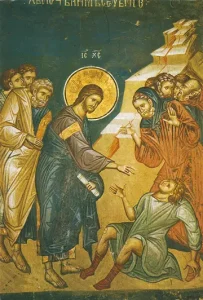
Did the Son of God ever get frustrated. Yes. Unless we want to think that when the Apostles couldn’t heal this epileptic boy, Jesus took time out to calculate quietly, “Let’s see. How much time till my crucifixion…?” I don’t think so.
When the Apostles can’t heal the boy, Jesus “loses it” for a minute. Time is passing. Holy Week and His death are almost upon Him. There’s so litle time left, and the Apostles are still not ready. “How long am I to be with you? How long am I to bear with you?” In church this Gospel, like all others, is read or sung so calmly, so sweetly. I wish somehow the clergy could put some feeling into it so the point comes across.
With a word He casts this demon out, and the boy is healed. Put yourself in the place of his father who loved him so much and had been so desperate, and now he has his boy back. I have children or grandchildren: this story always makes me misty-eyed.
There’s much else here worth talking about. The father’s words “Lord, I believe, help my unbelief.” That’s us. We have faith but not enough faith yet.
After He had settled down, his disciples went to Him: “Why couldn’t we do it?”And He explained: “This kind comes out only by prayer and fasting.” Different kinds of demons, different “diagnoses”! and different techniques to use on them.
And our need to pray and fast. It’s Lent.
But let’s go to the end.
He was teaching His disciples, “The Son of man will be delivered into the hands of men, and they will kill Him; and when He is killed, after three days He will rise.”
“And He would not have anyone know it” Why not? because He intended to die at the Passover, as the new Paschal Lamb sacrificed for the sins of the world. He doesn’t want to be well known yet lest the authorities hear and arrest Him before His time has come. Jesus was not a helpless victim. He was timing all this. He was in control throughout.
Next Week: Fifth Sunday of Lent: Saint Mary of Egypt – Repentance
Next after that: beginning of annual twice-daily Holy Week Posts