His Eminence Metropolitan Saba is Archbishop of the Antiochian Christian Archdiocese of North America
What follows here is one of Saedna * Saba’s consistently wise and pertinent weekly teachings. This one, published on December 5, 2025, speaks well to one of today’s issues in the Orthodox Church, which also was one of our topics in last week’s Post.
- “Saedna” is Arabic for “Master”, which in the Church has both respectful and and affectionate connotations.
If you wish to comment below, please do. We are expected to respect and honor our hierarchs and listen to them carefully. However, the Orthodox Church is not an authoritarian Church. We are allowed to disagree. It is said that ultimately Orthodox people are the guardians of the Faith.
Male and Female He Created Them, in Complementarity
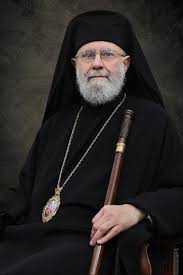
By His Eminence Metropolitan Saba (Isper)
It has long been repeated in popular Christian and secular discourse that Christianity is a “feminine religion,” evidenced by the predominance of women over men in Orthodox worship gatherings. This is not true everywhere.
Now, some accuse Orthodoxy of being “masculine” simply because they have observed an increase in young men joining the Church. Yet this phenomenon does not apply to all parishes, and therefore this claim is not accurate.
Both assumptions rely on local realities that differ from one country to another, and from one historical circumstance to the next. In countries ruled by totalitarian (communist) regimes, for example, the elderly dominated the attendance of the few churches that remained open. Is it reasonable to rely on that observation alone to claim that Christianity is a religion “for the old”?
Priests in our Archdiocese report that the influx into Orthodox Christianity is not limited to young men, as some media reports have suggested, nor is it accurate to portray this phenomenon as “masculine.” Today’s pastoral reality clearly shows that families are coming to the faith at a rate equal to, if not greater than, that of single men. These families include fathers, mothers, and children of all ages, all of whom find in Orthodoxy a deep spiritual environment, an integrated way of life, and a peace they desire to offer to their children.
These families also exhibit a mature awareness of complementarity between man and woman — not conflict, not competition. There are men who love their wives to the point of self-sacrifice, and work together with them in managing their family, financial, spiritual, and social life with joy and gratitude. In turn, women find in the Orthodox Church a place where they can fulfill their spiritual and human femininity in peace, for they are treated with love, respect, and honor — and because the husband is commanded to love his wife “as Christ loved the Church and gave Himself for her” (Eph. 5:25).
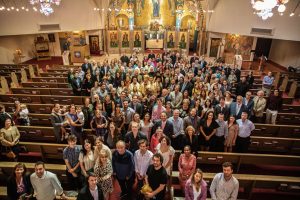
And if some young men today seem to find in the Church a space to fulfill their authentic masculinity, women likewise find in it a space to fulfill their authentic femininity. The Church does not view man and woman in terms of dominance or control, but in terms of complementarity: “There is neither male nor female, for you are all one in Christ Jesus” (Gal. 3:28). Thus, interpreting the phenomenon solely through the lenses of masculine or feminine lacks accuracy and does not reflect the pastoral reality we observe in our ministry. For all these reasons, this phenomenon must be studied with true professional depth rather than addressedthrough superficial journalistic impressions or even cultural presuppositions.
The Orthodox Church’s teaching, rooted in Scripture, says: “You know that the head of every man is Christ, and the head of the woman is the man, and the head of Christ is God” (1 Cor. 11:3), and, “For the husband is the head of the wife as Christ is the head of the Church.” (Eph. 5:23) Orthodox teaching has always insisted on reading these passages in their fullness, not in isolation. For the same text continues: “Husbands, love your wives as Christ loved the Church and gave Himself up for her… He who loves his wife loves himself” (Eph. 5:25, 28). Orthodox Christians have long joked that “the man may be the head, but the woman is the neck—and she turns him however she wishes!”
[Note from the Blogger in support of His Eminence’s point: At the Orthodox marriage service, the Epistle begins with Ephesians 5:21: “Submit to one another in the fear of God.” The text then goes on to explain how this can be accomplished without stepping on each others’ toes.]
Truly, many newly converted men and women find a peaceful life in the embrace of the Orthodox Church because Orthodox tradition preserves the dignity of both roles and offers a faithful interpretation of these texts. The man serves his wife and children with devotion, sensing that his masculinity demands this of him, while respecting his responsibility as the head of the household and his place as father and husband. The woman, in turn, finds inner peace knowing she is loved, respected, and supported by her husband. This is what we observe as pastors among our spiritual children in general.
Young people who have grown up amid comfort, softness, and an inability to face life’s hardships find in the Orthodox Church a spiritual fullness unlike what they experience in society. Thus, they are drawn to frequent fasting, long prayers, prostrations, confession, and living the Gospel commandments as they are — without humanistic reinterpretation. Most importantly, both men and women find in the Church a spiritual fatherhood that society has come to lack. Some statistics even say that since the 1980s more than 30% of children grow up without a father.
There is a masculine psychology and a feminine psychology that many ignore today. Our pastoral experience teaches that a man seeks in his wife the tenderness of the mother he misses, and a woman seeks in her husband the reassurance of the father she misses. Does not the man find comfort laying his head in his wife’s lap so she may stroke his hair when he is tired and anxious? And does not the woman find comfort laying her head on her husband’s chest, stroking her when she is weary and troubled? I am not a psychologist, nor a psychiatrist, but a pastor of souls, and I share what I have witnessed among many married couples, and in my long experience as a spiritual father.
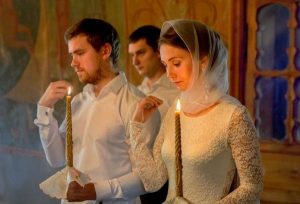
There is a complementarity between man and woman that the Orthodox Church proclaims. And it teaches that this complementarity requires a life of spiritual struggle and ascetic discipline, so that both may overcome the passions that push men to dominate women, and women to flatter or deceive men in self-protection.
One does not gain his or her rights by imitating the other or by suppressing his or her own personality, but by realizing his or her own true self. A man does not gain his freedom by dominating a woman, nor by feminizing himself, nor by abandoning his masculinity. A woman does not gain her freedom by becoming a second man, nor by abandoning her femininity. Without the struggle to purify and elevate the self, through the cooperation of both man and woman, the world will continue to witness injustice here and confusion of roles there.
Even if the majority of our newcomers were, in fact, men, this should not cause us dismay; rather, we should remember that the Holy Spirit bloweth where it will (John 3:8). Perhaps He brings more women to this parish, more men to another, more elderly to yet another still. What concern is this of ours? Should not we rather choose to welcome them warmly, rejoicing with our Father in Heaven for them? Should not we work diligently to care for those He has entrusted to us in every community?
When we understand this complementarity in souls striving for spiritual perfection, we understand why young people today in particular are coming to the Orthodox Church. For in Orthodoxy there is neither masculinity nor femininity, but a striving for complementarity, through the purification of the self from its passions.
I hope some qualified social scientists will undertake a serious, professional, and in-depth study of this phenomenon. Their research would benefit current and future generations—as well as the entire Church.
Next Week: Another edition of Orthodox Music for the Feast of Christ’s Nativity
Week after Next: God lying in His Mother’s Lap? Why in the world would anyone believe that?