Lest we forget:


The Third Sunday of Great Lent
It’s Mid-Lent. A good time to review your Lenten Rule. Is it too easy to be challenging? Too difficult to be kept? Say a prayer and adjust it, if need be.
Great Lent
Does the Holy Orthodox Church ever change? Actually, yes. But not often. Take as an example our Lectionary (schedule of daily Scripture readings), which apparently has been revised almost not at all since the Fourth or Fifth Century. As you’ve already been informed numerous times, our Lenten Scripture readings were aimed at converts who were streaming into the Church, now that Christianity was legal and even fashionable, as they were being prepared for Baptism at Pascha.
These catechumens were very different from our present surge of converts, most of whom have a Christian background, or at least have grown up in a society where many Judaeo-Christian values are taken for granted – even if in practice they’re presently fading fast.
Early Church converts were chiefly pagans, accustomed to the worship of many gods and goddesses. Morality in the Empire was often a matter of public reputation, rather than personal conscience before God. * Abortion and even infanticide were acceptable. Most had no knowledge of the Holy Scriptures. In other words, their Christian education needed to start from scratch.
- For example, this (from our Lenten lectionary) is something which the popular Roman world simply would not understand: “There are six things which the Lord hates, seven which are detestable to him: haughty eyes, a lying tongue, and hands that shed innocent blood, a heart that devises wicked plans, feet that make haste to run to evil, a false witness who breathes out lies, and a man who sows discord among brothers.” Proverbs 6:16-19
Catechumens attended church services and daily heard the Scriptures read and preached on.
As time went on, and most people in the Empire were Christian, Lent was retained as a season for all Christians to review and renew their commitment to their Baptisms and life in Christ – and that is Lent, as we know it today.
Epistle for the Third Sunday of Lent: Hebrews 4:14-5:6
Two chief points:
1 Jesus Christ, our eternal High Priest.
Priests in ancient religions offered sacrifices to placate the gods, to make peace between gods and men. Jewish priests, who inherited their office, offered sacrifices to the one God in the temple in Jerusalem, as directed by Old Testament Law, to show human repentance and dedication. You remember how the archangel startled the priest Zachariah, father of Saint John the Forerunner, when he went into the inner temple to offer the evening sacrifice of incense. And how when Jesus was forty days old, Joseph and the Virgin Mary went up to Jerusalem so the priest could offer the prescribed sacrifice: “a turtle dove or two young pigeons”.
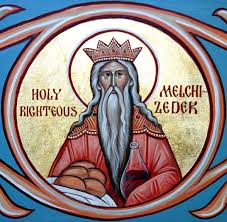
But now, in that same Jesus we have an eternal High Priest who inherited His office from God His Father, “a priest forever after the order of Melchizedek”. Melchizedek was a mysterious figure who appeared only once in Scripture, who was superior to Abram: *
- later renamed “Abraham”
“Melchizedek king of Salem [“peace”] brought out bread and wine. He was priest of God Most High, and he blessed Abram, saying, ‘Blessed be Abram by God Most High, Creator of heaven and earth. And praise be to God Most High, who delivered your enemies into your hand.’ Then Abram gave him a tenth of everything.” Genesis 14: 18-20
Melchizedek, a prefiguring of Jesus our great King and High Priest Who offered the one perfect sacrifice of Himself culminating with the Cross, uniting Heaven and earth – peace between God and mankind forever. Just as Melchizedek seemingly appeared out of nowhere, our Lord Jesus suddenly came from Heaven. He commanded the Holy Eucharist, Bread and Wine. He is superior to Abraham, and brought a New Covenant, superior to the Old. Just as Melchizedek then was seen no more, Christ has ascended into Heaven. “A Priest forever after the order of Melchizedek.” An obvious prefiguring of Christ.
2 “What a Friend We have in Jesus”
That’s a Nineteenth Century Protestant Evangelical hymn. We sang it a lot when I was a kid. (I wonder if they still do. Fashions change in most Protestant churches.) I used to make fun of it. I was wrong. It spoke the truth.
Courtesy of panoplyimaging
What kind of High Priest is Jesus? Not one who stands far off in Glory and “lords it over us”? No. Jesus our Lord is our Friend. He “sympathizes with our weaknesses”, because He “in every respect has been tempted as we are”.
Is that hard to believe? Only if we think He is not fully human. When He was young, He was tempted as teenage boys are, and then as young men are. And then, in addition to all the temptations all we adults face, beginning when He was thirty, He began to be subject to temptations far greater than we can conceive: to turn against His Father and pull the moral universe down into chaos. He submitted Himself even to that.
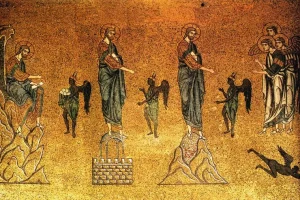
Brothers and sisters, our dear Lord stands here right beside us. He knows what it is like to be tempted.
He sympathizes with your weaknesses, because He was, He still is like you. Do not ever fear to turn to Him for help when you are tempted. He understands.
Sunday of the Holy Cross
Courtesy of Domkov17
Holy Gospel for the Third Sunday of Lent: Mark 8:34-38; 9:1
This Sunday we are half-way through Great Lent, and we begin to turn our attention towards the what it all leads to, both for Jesus and or us.
I once visited a man in our county jail, who had broken all of the Ten Commandments and a few more, and was not the least bit sorry about it. “Jesus died for my sins. I’m saved.”
Wrong.
Not only did Christ die for us. He called us to die with Him.
Let’s begin with the Gospel passage immediately preceding this one. Jesus’ disciples had been with Him for some time, and finally He had asked them the big question. “Who do you say I am?” Surely they had been talking about this among themselves. Simon Peter, always impulsive, blurted it out: “You are the Christ, the Son of the living God”. Jesus accepted that title. “Blessed are you, Simon son of Jonah. Flesh and blood have not revealed this to you, but my Father in Heaven.”
“So we’ve been right! We are following the Messiah, the King! Now we’ll march with Him into glory!” That’s what they all figured.
Then, for the first time, Jesus began to tell them He must suffer and be rejected and killed, and then rise again. I suspect they were shocked almost beyond words. The idea of the Messiah suffering and dying was just… horrendous, unspeakable, execrable. It was the last thing they expected to hear Him say, the last thing they wanted to hear. Imagine if one of your heroes announced it was his policy to let his enemies destroy him.
This was worse. Everyone knows the Messiah will come to conquer his enemies, drive out the Romans, establish a Jewish nation. Or those of a more spiritual bent believed the Messiah would drive out the devil and bring in the Kingdom of God.
Jesus is going to die? This wonderful young Man whom they had come to know and love and admire and trust? This can’t be right. Peter blurted out again, “No, Lord, we will never let this happen to you.” Jesus responded, “Get behind me, Satan. You think as men think, not as God thinks.”
The apostles must have been utterly bewildered.
That brings us to Sunday’s Gospel reading.
Then “He called the people to Him with His disciples and said: ‘If anyone wishes to ome after Me, let him deny himself and take up his cross and follow Me.”
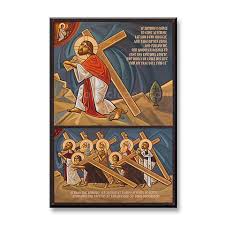
His “cross”? This was even worse. Everyone knew what a cross was – the Roman way of killing criminals, who were required to carry the cross-bars of their own deaths out to the place where they would be executed. With a shudder they imagined Jesus taking up His cross, being crucified, suffering excruciating pain as He scrambled to breathe, and then dying. Lord, have mercy.
And then: I am to take up a cross? Did He mean that we all are to be crucified?
The answer is: No, He didn’t , and Yes, He did.
A very few, like the Apostles Simon Peter and Andrew were literally crucified. But here Christ was speaking in symbols, as He so often did. He would make His Crucifixion a sign of something deeper.
Let’s say first what taking up our own cross does not mean. It does not mean we should seek to suffer: “Oh, hit me again, make me hurt some more”. That’s not piety. That’s neurosis, masochism, a martyr complex. That’s not what He meant.
The way of the cross is a symbol of dying to ourselvs and our selfish will, of obedience, as Christ was obedient to His Father. He followed God’s will wherever that led Him, from His conception in the womb of the Theotokos, to its culmination on Calvary, and so into His Resurrection. He is the eternal “Lamb, slain from the foundation of the world.” Revelation 13:8
For us to take up our cross means simply to follow Jesus, obey God as He did through life into death. Most of us will have many joys along the way, as did He. We also will have some suffering along the way in one form or another. Nobody escapes that. And at the end we all will die with Him. But the way of the cross is not about losing ourselves forever.
Listen closely to Him: “Whoever desires to save his life will lose it, but whoever loses his life for My sake and the Gospel’s will save it.” He is telling us how to gain true life, how to attain lasting joy, how to find our true selves. On the Cross Jesus wasn’t throwing His life away. Look what it led to. And that is what He wants for us. “I came so you might have life and have it abundantly.”
So we gain our lives by losing them? That sounds paradoxical. It is not. And it’s no secret. If we’re wise, we do it every day. God has built it into the nature of things.
If you want good health, you’d better deny yourself drugs and smoking and binge-drinking and driving like a maniac and gobbling down fatburgers. If you’re ill, you may have to deny yourself comfort and undergo painful surgery now, if you want to attain long life. We willingly make personal sacrifices, take up these “crosses”, so to speak, for the sake of long term gain.
There are a multitude of examples.
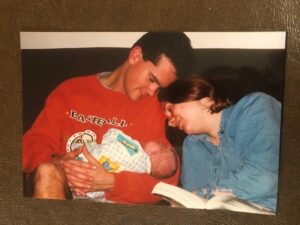
Parents: When our first grandson was newly born, I remember hearing our daughter upstairs crying, “I want my old life back.” She never got it back. She gave it up. What she got instead was a beautiful new life: three children (grown now) who love her like crazy, and a husband who loves and admires her for what she did.
It hurts to give a lot of money to charity and church, when you could be spending it on yourself. It’s a sacrifice to get up and go to Liturgy on Sunday mornings when it would be so nice to snuggle under the covers and sleep in, then have a big breakfast at home. It’s a sacrifice to take some of the money we’d rather spend on ourselves and give it to the needy. It’s hard to be kind to nasty people, not pay them back, when they so obviously deserve it. It hurts, sometimes it’s very hard, to swallow our pride and apologize, or to swallow it and forgive. Or to keep your mouth shut when everybody else is gossiping. Or to tell the truth and do a good job when you could get away with lying and cheating. Or when you know it may even cost you your job in order to keep your integrity and do what is right and honest, when company policy is otherwise. In so many ways, it requires sacrifice to keep our eyes on the prize and focus ourselves on God’s will and on following Christ. That is our “cross” which we must “take up” willingly, just as Christ took up His Cross.
It requires enormous interior self-sacrifice to remain faithful to Jesus Christ and His love, when it seems, it feels like He isn’t loving us. Just as He felt briefly: “My God, my God, why have You forsaken Me.” But then He recovered and cried “Into Your hands I commit my Spirit”.
If we believe in Jesus Christ, if we believe in eternity, if we want to have Life in the end, then we gladly make these sacrifices. It’s only good sense, truly “enlightened self interest”, as some call it.
But stop! We’ve been talking about following Christ for the sake of future joy. That’s not the whole story. Fact is most of the time following Christ is not burdensome. “My yoke is easy, my burden is light”, He said. People complained the Son of Man came eating and drinking. Even though He knew what lay ahead, Jesus had much joy in His life.
At the end of today’s Gospel He said: “I tell you: some standing here will not taste death till they see the Kingdom of God come in power.” He was speaking chiefly of His coming Resurrection and Pentecost. But I think it also means that joy in the Kingdom of God is something each of us can begin to know now, before we taste death.
As we follow Christ, something wonderful comes alive in us now. We know a deep inner joy now when we draw near to God, when we love people, when we do what is right, when we keep our integrity, when we follow Him through thick and thin. This isn’t “pie in the sky by and by”, as some call it. It begins now.
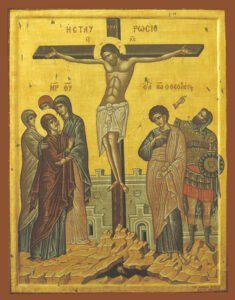
Jesus hanging on the cross, for all the pain, deep in His heart knew that joy. He had been faithful to the end. He had accomplished what He came to do, and He cried from the cross: “It is finished!” I’ve done it! And He closed his eyes in death, His heart at rest. Look: He is not in agony. He is at peace on the Cross. In Orthodox icon of the Crucifixion. In some His face has an almost “self-satisfied” expression.
By the nature of things, that kind of faithfulness, that kind of goodness, that kind of integrity, that kind of joy cannot die. It lasts forever into the Kingdom of Heaven.
With His help, and we so choose, we can come to end of our lives still faithful, still repentant, and say with Him: It’s finished. I’ve done it. I never gave up. I’m still following You, Lord. And then we can die with the same deep joy He had on the Cross, which will now go on forever. “On the third day He rose again.” And we can rise with Him, if we will.
Listen again to the Troparion of the Cross. Nothing sad and sentimental here. This is a hymn of power, of victory.
On the other hand He also said it negatively: “For what will it profit you to gain the whole world and lose your soul?” Your soul, that deepest inner you, the essence of you – you can lose that. You can go for the externals, money and fame and power and pleasure and popularity and pride and getting your own way – all that stuff the fallen world tells us we must have – and then get to the end of your life, and all you have is the world and it will be: Goodbye, world, and you’ll have nothing to take with you. The true you, the you intended for eternity, your soul will be gone. If you come to the end of life like that, Jesus says, it will be too late. There’s no way to get your soul back then, and “the Son of Man will be ashamed of you when He comes in glory with the holy angels”. Ashamed because of the great gift He gave you, which you just threw away, wasted.
Brothers and sisters, this is tough talk from the Lord Jesus, because this is for Real. As you go through life day by day, hour by hour, you decide your future, whether to save your soul or lose it. Don’t blow it.
Choir of Holy Theophany Orthodox Church (OCA), Colorado Springs, Colorado
As we venerate the Holy Cross of Christ this Sunday morning, we will sing “Before Thy cross we bow down in worship, O Master…” When you prostrate before the Cross of Christ, you are not doing something morose. You are saying: “Lord, I want to live, I want to save my life. I want joy forever, I want to live with you in the Resurrection.”
That is why we conclude like this: “And Thy holy Resurrection, we glorify.”
Next Week: Fourth Sunday of Great Lent: Saint John Climacus – Climbing the ladder to Heaven
Week after Next: Fifth Sunday of Great Lent: Saint Mary of Egypt – Repentance and Holy Confession