Do not fret because of him who prospers in his way,
because of the man who brings wicked schemes to pass.
Cease from anger, and forsake wrath;
do not fret—it only causes harm.
For evildoers shall be cut off;
but those who wait on the Lord, they shall inherit the earth.
For yet a little while and the wicked shall be no more;
Indeed, you will look carefully for his place, but it shall be no more.
But the meek shall inherit the earth… Psalm 37:7-11
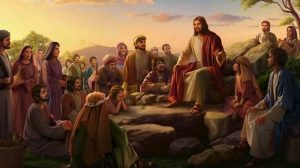
Given the state of so many things today, I just thought I’d begin with that.
Saint Gregory Palamas
Each Lenten Sunday has a particular theme. This next Sunday it’s Gregory Palamas, and we talk theology. I’ll try to make this simple, because that’s the only kind of theology I can understand.
Here was the issue: Can we know God? or can we only know about God?
These may seem absurd questions. After all, we worship God, pray to Him, and depend on Him all the time. But actually it is reasonable to ask. For if God is “ineffable, inconceivable, invisible, incomprehensible”, as we pray in Divine Liturgy, if He “dwells in unapproachable light, whom no man has seen or can see…” 1 Timothy 5:16, how can we poor human beings possibly know Him? have a personal relationship with Him?
These were big issues back in the Fourteenth Century, the time of Saint Gregory Palamas.

Gregory Palamas was born into a notable Orthodox family, probably at Constantinople, in about the year 1296. After his father’s death, to the surprise of his family, he became a monk on Mount Athos. He was dismayed by the laxity of many of the monks there, but he found an elder who taught him the old way of Hesychasm, the prayer of silence, centered on the Jesus Prayer. For the next twenty years Gregory followed the Rule of Saint Basil and lived chiefly in silence, focussing on praying “Lord Jesus Christ, Son of God, have mercy on me, a sinner.”
Many monastics followed his pattern, and some claimed that through Hesychasm they sometimes saw the Uncreated Light of God, such as the Apostles Peter, James and John saw at the Transfiguration of Christ. So far as I can find, Gregory never claimed he had experienced this himself.
In the 1330s, the practice of Hesychasm was attacked by Orthodox men like Barlaam of Calabria who had been trained in Italy by Roman Catholic theologians. If I understand this right – and please correct me, if I’m wrong – they taught that human beings cannot know God directly. We can only know about God intellectually.
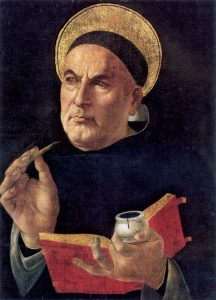
I think this came out of an extreme interpretation of the theology of Thomas Aquinas, a Thirteenth Century saint of the Roman Catholic Church, who in his Institutes taught that philosophy and rationalism were the proper approaches to God. (I tried to read Aquinas. It was beyond my understanding. If you want to give it a shot, feel free.)
Followers of theologians (and politicians) often take the principles of their heroes to extreme, illogical conclusions. Note: it was said that before Aquinas had finished his Institutes he had some sort of mystical experience, after which he stopped writing, saying it was only “dust and straw” compared to what he had seen.
The “Barlaamites” made no sense, even in the Roman Catholic Church, where people prayed to God all the time hoping for a response from Him, and (just as in the Orthodox Church) some had mystical experiences – although the vision of the Uncreated Light of Tabor seems to be a strictly Orthodox phenomenon.
The theological question
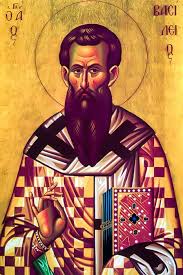
If God dwells in inaccessible light, how can we possibly know Him, have a relationship with Him? Saint Basil the Great, in the Fourth Century, made the distinction between God’s essence and God’s energies. I think we hear little or nothing about this till the Fourteenth Century, because it had not been an issue. Now Saint Gregory Palamas stressed it.
Here’s the doctrine: We cannot know God in His essence, nor will we ever, inasmuch as He “dwells in inaccessible Light”. However, we can know God in His energies.
Let me speak for myself: For a long time I just could not grasp the concept of God’s energies – until I realized I was only getting hung up over the word. “Energies” is just a word to express the fact we do experience God’s Living Presence. Forgive me for taking this from AI *, but it’s such a succinct definition: “ἐνέργεια (enérgeia) is an Ancient and Modern Greek feminine noun meaning ‘activity’. Coined by Aristotle, it literally means ‘being at work’ or ‘power in action’.”
- of which please be very very careful

Analogy: Do we experience the sun? In its essence, no. The sun itself is hidden from us in inaccessible light. However we do experience the sun and its power through sunlight, its “energies” which make life possible.
Another analogy. Can we experience what is going on within another person’s mind and soul? No. That “essence” of the person is hidden from us. However, we can know and relate to that person through his or her words, tone of voice, physical posture, even way of dressing and hairstyle – that is, through their “energies”.
Now, this is very important: Do not go chasing after mystical experiences or trying to see the Uncreated Light of God. These are gifts of God, not the reward of human effort. To go seeking them can lead to delusion from the devil. However we can make ourselves open to them, so that God can reach out to us, if He so chooses, for our good. The Hesychasts on Mount Athos were praying the Jesus Prayer because praying to God is the right thing to do. In the midst of this, God occasionally chose to reveal the Uncreated Light of His Essence. He showed them just a glimpse of it, so to speak, so that it didn’t overwhelm them. But they were not going after the Light. They were just praying.
We can experience the Presence of God in a multitude of ways. He can touch us when we pay careful attention to (instead of just rushing by) the beauty which He has created in art and music and poetry and in nature. Who does not feel the presence of God when watching a beautiful sunset?
Here is my peculiar personal witness, offered just so you won’t feel odd about the ways you experience God’s presence. I find Him especially in music. He touches me in some religious music, both Eastern and Western, but (forgive me) often more so in some classical music and other good music from my youth, even some jazz. I listen closely to it and think “How great You are, that You have created such beauty through mere vibrations and rhythm – through music”. I’ve told you that He once healed me of grief through the movie “Mary Poppins”! I felt bad about that at first: why wasn’t my religion helping me? till I finally realized that God isn’t limited to religion. Maybe I’m secular at heart? That doesn’t stop God.
“God works in mysterious ways”, some of them completely unanticipated (believe me) through His energies which fill all things. Please be prepared.
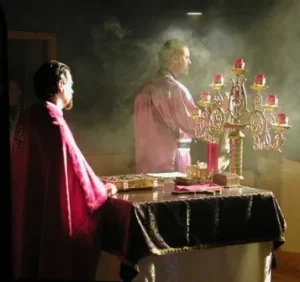
However, of course and far above all, we find God and know Him and meet Him and love Him and hear Him in our Lord Jesus Christ and through His sacramental Mysteries. “He who has seen Me has seen the Father”. John 14:9 “For I have not spoken on My own authority; but the Father who sent Me gave Me a command, what I should say and what I should speak.” John 12:49 “This is My Body which is given for you; do this for the remembrance * of Me”. Luke 22:19 This is our guaranteed place of meeting with Jesus Christ. This why the Church celebrates the Divine Liturgy every Sunday.
- Aνάμνησις (anamnēsis), which in New Testament Greek means to make a past event present. A literal “re-calling”. I wish we would get this straight in our English translations.
The Remainder of Saint Gregory’s Life
So did theology of Essence and Energies solve the problem? Of course not.
This was a time of political tension between Byzantium and the Western Roman Empire. Byzantium was weak, and the Emperors were willing to compromise with the West in order to obtain military support from them against the Turks. Thereby the theological issue took on political implications. Some other Orthodox theologians took up the Roman Catholic view.
That meant that the rest of Gregory’s life was complicated and largely unpleasant. In 1341 an Orthodox Council in Constantinople vindicated him and his teaching. Then, under pressure from the Latin element, in 1344 he was excommunicated. Three years later Gregory was restored and consecrated Archbishop of Thessaloniki, but he had to enter his see with military aid from the emperor. Then in 1354 the Turks captured him and kept him prisoner for a year. He was able to return to Thessaloniki and serve as archbishop only briefly, and as a very weary man.
Gregory Palamas died on November 14, 1359, and was formally declared a saint in 1368 by the Synod of Constantinople. His theology, his example and his intercessions have guided the Orthodox Church ever since,
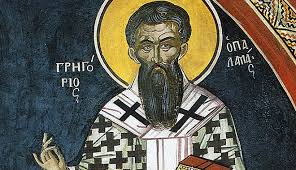
Saint Gregory Palamas, pray for the salvation of our souls.
This Sunday’s Scripture Readings
To repeat: The theme of most Lenten Sunday Readings is the Identity of Jesus Christ, directed at Catechumens, so they will make no mistake. They will be committing themselves to no merely human teacher, but to God Himself Incarnate in Jesus of Nazareth.
Commentary is fairly short this time, so I’ll make life easy for you and include the texts.
Saint Paul’s Letter to the Hebrews: 1:10-14; 2:1-3
In the beginning, You, Lord, founded the earth in the beginning, and the heavens are the work of Your hands; they will perish, but You remain; they will all grow old like a garment, like a cloak You will roll them up, and they will be changed. But You are the same, and Your years will never end.” But to what angel has He ever said, “Sit at my right hand, till I make thy enemies a stool for your feet?” Are they not all ministering spirits sent forth to serve, for the sake of those who are to obtain salvation? Therefore we must pay closer attention to what we have heard, lest we drift away from it. For if the message declared by angels was valid and every transgression or disobedience received a just retribution, how shall we escape if we neglect such a great salvation? It was declared at first by the Lord, and it was attested to us by those who heard Him.
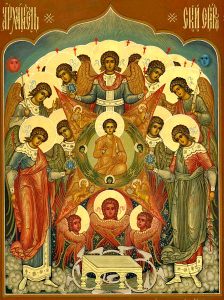
I wish the Fathers had included more from the first chapter of Hebrews, which begins “In these last days [God] has spoken to us by His Son, whom He has appointed heir of all things, through Whom He also made the worlds…” This Man, born only a few years earlier in a small village in Palestine, is the One through Whom God made the worlds! An extraordinary, outlandish, seemingly absurd thing to say. Yet that is what Christians have said from the beginning.
In context, the first chapter of Hebrews makes the point that Jesus Christ is superior even to the holy angels. It quotes passages from the Old Testament in which God seems to be talking to Himself, as if there were some kind of bi-personality within God “You are my Son. This day have I begotten You.” Psalm 2:7 “I will be to Him a Father, and He shall be my Son.” 2 Samuel 7:14 These and many other passages were understood by the Jews to refer to the coming Messiah. These were quoted by Jesus to stump his adversaries during Holy Week: “If the Messiah is David’s son, how can He also be his Lord?” There is only One Answer to that. The Son of God, born into the family of David, has walked among us, the One Who shall remain forever and be the same after the cosmos has been “rolled up like a cloak” and be no more.
You catechumens, listen! If the Jews were punished for disobeying God’s Law, which had been revealed by angels, what do you suppose will happen to you if you neglect salvation declared at first by the Lord, the Son of God, and attested to us by those who heard Him directly? – most of whom were still alive when Hebrews was written.
Brothers and sisters, how do you suppose this applies to us, as we read the Gospels? What will happen to us if we neglect “so great a salvation”?
Mark 2:1-12
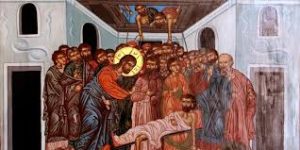
At that time, Jesus entered Capernaum and it was reported that He was at home. And many were gathered together, so that there was no longer room for them, not even about the door; and he was preaching the word to them. And they came, bringing to Him a paralytic carried by four men. And when they could not get near Him because of the crowd, they removed the roof above Him; and when they had made an opening, they let down the pallet on which the paralytic lay. And when Jesus saw their faith, He said to the paralytic, “My son, your sins are forgiven.” Now some of the scribes were sitting there, questioning in their hearts, “Why does this man speak thus? It is a blasphemy! Who can forgive sins but God alone?” And immediately Jesus, perceiving in his spirit that they thus questioned within themselves, said to them, “Why do you question thus in your hearts? Which is easier, to say to the paralytic, ‘Your sins are forgiven, ‘ or to say, ‘Rise, take up your pallet and walk? But that you may know that the Son of Man has authority on earth to forgive sins”-he said to the paralytic-“I say to you, rise, take up your pallet and go home.” And he rose, and immediately took up the pallet and went out before them all; so that they were all amazed and glorified God, saying, “We never saw anything like this!”
Great crowds were gathered around Jesus, as usual. I don’t know how he coped with it. As we know, sometimes He couldn’t and escaped by Himself to rest and pray.
Four men let their crippled friend down through the roof. * Once He got over the surprise, Jesus immediately said to the man, “Son, your sins are forgiven.” An odd way to begin. Was there some connection between the man’s spiritual condition and his physical condition? We’re not told.
- Summers were hot. No air conditioning. So roofs had large vents, covered in cool weather, but open in summers in order to let the heat out.
The Lord knew what the scribes were thinking (He has that ability, never forget.): “Who does He think He is? Only God can forgive sins.” So He took up the “dare”. “To prove that the Son of Man * has the authority to forgive sins…” He commanded the man to take up his bed and walk – and he did.
- There’s that Messianic title again. See last week’s Post.
That’s really the end of the story. Who is Jesus of Nazareth? He is indeed the One who can forgive sins. He is God Incarnate.
Next Week: Third Sunday of Lent: Sunday of the Holy Cross
Week after Next: Fourth Sunday of Lent: Saint John Climacus