A blessed and refreshing and challenging Lent to you!
This year during Lent (and perhaps through Paschal season as well) we’ll concentrate on the Sunday Scripture readings and themes of the season. We haven’t done this for a while.
The Sunday of the Triumph of Orthodoxy
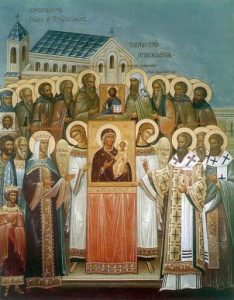
After all these years, I still feel slightly whiplashed by this First Sunday of Great Lent. For a week we’ve been in the the Lenten Fast with its sombre violet. Then suddenly on this First of Sunday of Lent here comes the gold of the Sunday of Orthodoxy and our celebration of the Restoration of the Holy Icons.

However, it does all fit together – likely not by the plan of the ancient Orthodox liturgists who seemed to delight in piling different themes on top of each other. No, the Holy Spirit did it again!
Let’s first take a side-trip to talk about our Lenten Scripture readings, which were originally aimed at catechumens in the early Church who were preparing for Holy Baptism at Pascha.
Weekday readings are from the Old Testament. To oversimplify the themes: Genesis (the Judaeo-Christian outlook on God and reality), Proverbs (the good life, and how to live it and avoid the evil), Isaiah (prophecy of the coming of the Messiah). I hope you’ll take time to keep up with these Scripture readings, which are foundational to our Faith. See https://www.antiochian.org/liturgicday
It goes without saying (so I’ll say it anyway) that many Orthodox do not know the Scriptures very well. Praise God for the influx of many young Evangelicals who are bringing their Bible knowledge into the Church. End of sermon.
The First Sunday of Lent
Lenten Sunday Epistle readings from Hebrews take several themes. This Sunday’s Epistle Reading (Hebrews: 11:24-26, 32-40) speaks of the dreadful tribulations great Old Testament heroes and heroines suffered “of whom the world was not worthy”… The point: You catechumens, if you think being a Christian is supposed to be a “piece of cake”, forget it. This is going to be difficult, and so it was. Even if we’re not being persecuted, it will be tough for us, as well – sooner or later, in one way or another. Don’t let it take you by surprise. The rigors of Lent are training to get us ready.
Lenten Sunday Gospels were appointed to teach catechumens who Jesus Christ is, so there would be no confusion in their minds as to the identity of this God-Man to whom they were about to commit themselves.
This Sunday’s Gospel Reading (John 1:43-51) takes place early in Jesus’ ministry. He had been baptized, then tempted forty days in the desert. Now He had gone home, north to Galilee, and was calling disciples: Andrew, his brother Peter and Philip, then James and John.
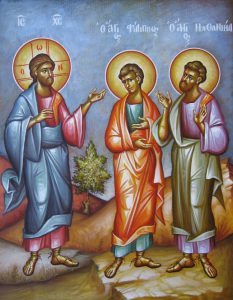
Today Philip finds Nathanael * and cries excitedly: “We have found the Messiah, Jesus of Nazareth”. Nathanael responds: “Can anything good come out of Nazareth?”
- almost certainly the same as the Apostle Bartholomew. Men often had both Greek and Hebrew names.
Nazareth was a village * up in the hills. Nobody important had ever come from there, nor were there prophecies that the Messiah would come from there.
- Today the population is over 75,000.
Nathanael might have answered in a mannerly tone: “Really? Tell me more.” Instead he said, in a kind of smug, pseudo-sophisticated way: “Can anything good come out of Nazareth?” Now, I know some interpret this response very seriously. For myself, I think Nathanael was being what we call a “smart aleck”.
Philip didn’t argue. He responded simply: “Come and see”.
Jesus saw Nathanael coming: “Behold, an Israelite indeed, in whom there is no guile!” No pretense here! Read this as you will, but I think the Lord was poking fun at him: “no pretense” indeed! But Nathanael took him seriously: “How do you know me”? and my sterling character. So Jesus threw another one at him: “Before Philip called you, I saw you under the fig tree.”

This startled Nathanael. Why? because in that region fig trees were big, had low hanging branches, so in the midday heat you could go inside to cool off. Nobody could see in there. “How ever could He have seen me under the fig tree?”
Now, we are likely missing parts of the conversation here. As Saint John pointed out, all the books in the world could not contain everything Jesus did and said. No matter, at the end Nathanael cried: “Rabbi, Teacher, You are the Son of God, You are the King of Israel!” I wonder if Jesus thought to Himself: “That’s all it took? You were an easy catch! Nathanael, now you are indeed without guile.”
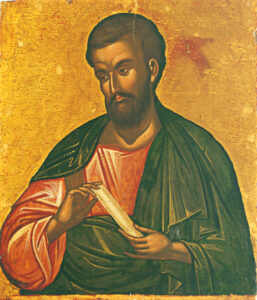
Then aloud: “You believe because I saw you under the fig tree? You will see greater things than that. You will see Heaven opened and the angels of God ascending and descending on the Son of Man”. And so he did. Jesus took this once-shallow man Nathanael and showed him miracle after miracle, the Crucifixion and the Resurrection and the Ascension, and turned him into the faithful Apostle Bartholomew who spent the rest of his life carrying the Gospel of His Lord Jesus Christ – to Arabia, maybe as far as India, then back to Persia and finally to Armenia where tradition says he was crucified and died – all for this Man who “came out of Nazareth”.
I just love that story. I couldn’t resist going through it again. But remember that these readings were intended to teach catechumens who Jesus is. And I think what the Fathers were really going after in this Gospel are all the titles of Jesus therein. Catechumens, listen carefully: Who is this Man Jesus of Nazareth?
1) He is the Son of God, of the same essence as God the Father, just as a human son is human like his father.
2) He is the King of Israel, the Messiah whom the prophets had foretold.
3) He is Jacob’s Ladder, the one upon whom angels of God ascend and descend. Remember: the patriarch Jacob in a dream had beheld a ladder set up on the earth, the top of it reaching to Heaven, and behold, angels of God were ascending and descending on it. When Jacob woke from sleep he thought “Surely the Lord is in this place, and I did not know it.” He was afraid and said: “How awesome is this place, this is the dwelling place of God; this is the gate of Heaven.” Genesis 28 Jesus is the ladder uniting Heaven and earth. The Lord God is in this place, in this Man, Jesus of Nazareth. He is the Gate of Heaven.
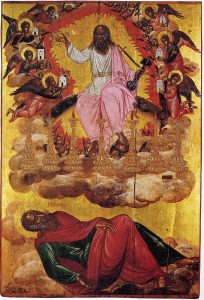
4) He is the Son of Man, which means He is human, but also much more than that. In chapter 7 of the book of the Prophet Daniel, Daniel saw a vision of God the Father in glory – he calls Him the “Ancient of Days” – “His throne flaming with fire, a river of fire flowing out from before Him. Thousands upon thousands attended Him; ten thousand times ten thousand stood before Him. And “then… I looked and saw one like a Son of Man, coming with the clouds of heaven. He came to the Ancient of Days and was led into His presence. To Him was given authority, glory and power; all peoples, nations and men of every language worshiped Him. His dominion is an everlasting dominion that will not pass away, His kingdom is one that will never be destroyed.” That is what “Son of Man” means. That is who the Man Jesus of Nazareth is.
The Archangel Gabriel repeated these words to the Virgin Mary, and we recite them again in the Creed: “His kingdom shall never end.”
Early on Holy Friday morning Jesus was on trial, and the high priest asked Him, “Are you the Christ, the Son of the Blessed?” For the first time Jesus said, “I am, and you will see the Son of Man seated at the right hand of Power, and coming with the clouds of Heaven.” Matthew 14:61-62
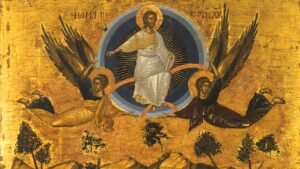
Listen, you catechumens: Christianity is no ordinary religion. Jesus is no ordinary man. He is unique. He is the Alpha and the Omega, the Beginning and the End of all things. His Kingdom is forever. In Him is the key to all things, in Heaven and on earth, in life and death and what comes after death. Jesus of Nazareth is the one true God made Man.
And that leads us directly to:
The Sunday of the Triumph of Orthodoxy
For over a hundred years in the Eighth and Ninth Centuries the Iconoclastic Controversy had raged, on and off and on again. Murals had been whitewashed over, countless icons destroyed. Most ancient iconography was lost.
What was this all about?
The issue was not art, not pictures. I mean, who would die or be imprisoned for decades to protect even the Mona Lisa?
1 Does the state have power over the Church? Strangely enough the Iconoclastic emperors, beginning with Leo the Isaurian who came to the throne in 717, never explained exactly why they so despised icons. Were they influenced by the iconoclastic Muslims who kept winning battles? No matter, the issue quickly became power and authority. Did civil authorities have the right to rule the Church? tell the Church what to believe, how to worship? The answer, of course, is No.
At the time many bishops and priests (who owed their living to the state) gave in. However, many monastics (who had less to lose) resisted. Some were imprisoned, exiled, a few even executed – to make the point that no civil authority has the right to rule the Church of God. (Would somebody please explain that to Kirill, Patriarch of Moscow and all Russia?)
Many laypeople resisted. There was a public riot when soldiers pulled down the great icon of Christ over the gate of Constantinople. Why did the laypeople react so strongly against Iconoclasm? For one thing, they knew the Faith of the Church. Orthodox people have always been the guardians of the Faith. For another: “Keep your grubby hands off these precious icons my grandmother gave me!”
However, the great issues were theological.
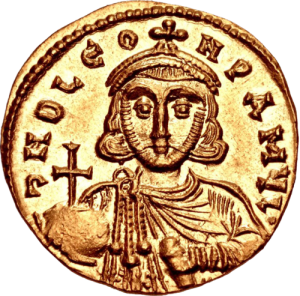
2 Did the Old Testament ban images? Some Christians and Muslims believe this. Here is one answer to that: Then get serious about it as some Muslims do. “All images” means “all images”: Out with the TV, out with the teddy bears, out with the picture of grandma, out with all those icons on your computer. The Iconoclasts didn’t really believe this. They wanted to throw out images of Christ, but not images of the Emperor! Evidence to the right:
What the Old Testament actually forbids is the worship of images of false gods. * The Orthodox Church agrees with that. Icons are not images of a false god. They are images of the true God. They depict God now incarnate, enfleshed, visible in Jesus Christ, the Son of God. Something new has happened since Old Testament times. God has taken on an εἰκών, an “image” an “icon”. Therefore He can now be iconed, imaged. Besides, do we worship icons? Of course not! Who ever worshiped wood and paint? We worship the One depicted in the icon.
- See: https://www.saintjohnchurch.org/does-the-second-commandment-forbid-icons/
In the year 783 the Seventh Ecumenical Council declared that images not only may but must be used in Church, as a necessary witness to the Incarnation. We’ll recite part of their decree at the end of the procession in church on Sunday.
But why do we venerate icons of his saints? Because the Church is the Body of Christ, the extension of His Incarnation. Indeed, all the people of God are Christ’s visible presence on earth. If you become entirely faithful during your time on earth, someday there could be an icon of you.
The Seventh Council had condemned iconoclasm – but still the conflict went on for another sixty years till Empress Theodora came to the throne. On March 11, 847, the First Sunday of Lent, she and Patriarch Methodios carried the holy icons in procession into the great church Aghia Sophia in Constantinople, thus restoring them once and for all to the Church. Ever since that day, in our churches and in our homes, even sometimes in our work places, if it’s permitted, our icons witness to the truth that Jesus Christ is God made Man. Iconoclasm has never again arisen in the Holy Orthodox Church.
Much later, some radical Protestant iconoclasts smashed and burned images in Roman Catholid churches, but that’s another story.
3 One thing more: Icons witness to our Orthodox understanding of the Church. The Church is not primarily an institution. Rather we’re a family, a fellowship of people who are brothers and sisters in Jesus Christ, a community of love transcending Heaven and earth. As we worship we are surrounded by icons of our heavenly family.
How to explain this to our non-Orthodox brothers and sisters? Don’t try. Instead do as Philip did with Nathanael: “Come and see.”
The Sunday of the Triumph of Orthodoxy
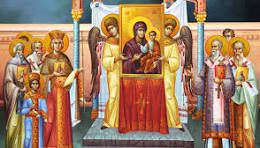
Why ever should we title this the Triumph of Orthodoxy? instead of the triumph over Iconoclasm?
Do we Orthodox rule the world? Once we thought we did, but we didn’t. Nor should we expect to. Jesus said His kingdom is not of this world.
Orthodoxy is triumphant because it endures. In two ways:
1 Historically. The Roman Empire, Crusaders and Mongols and Communists all had their day and are gone. The Holy Orthodox Church endures. Patriarch Bartholomew says he won’t move the Patriarchate of Constantinople elsewhere because the Turks “have been here only four centuries”! In my lifetime Orthodoxy in Russia survived decades of horrendous Communist persecution – and so it will survive Vladimir Putin. (Kyrill is not the only Orthodox Patriarch who ever sold out to civil authority.)
Likewise we can see from history that denominations of all sorts eventually fail. Where today are the Arians, the Marcions, the Nestorians, the Pelagians, and so many more? In the same way, today’s denominations will eventually either return to Orthodox Faith, or they will fail. They have no solidity, no lasting power. You can see that from the way they forever reshape and reassemble themselves. They know they’re incomplete. Mainline American Protestantism seems even now to be on the way out.

In the same way today’s secular political theories and parties, both of the left and of the right, will pass. I’ve watched them change their stripes several times just in my lifetime.
But The Holy Orthodox Church endures.
2 Even more importantly, the Orthodox Faith endures.
The Holy Orthodox Faith in the Holy Orthodox Church just keeps going on and on and on. The Restoration of the Holy Icons, 1200 years ago, was the last theological controversy in the Orthodox Church. * Even the Iconoclastic Controversy was a manufactured issue: If it hadn’t been for a few nasty emperors, it would have amounted to nothing.
- Well, there was a little kerfuffle back in the 17th Century, when one of our patriarchs developed Calvinistic tendencies, would you believe? Nobody followed him, and the Muslims strangled him.
The theological issues that today are tearing apart the various denominations and churches affect us Orthodox almost not at all. Does anything ever change here? Yes. but as Father Alexander Schmemann put it, “The Orthodox Church changes only in order to remain the same”! The Orthodox Church changes very slowly and deliberately, guarded by and never departing from “the Faith which was once delivered to the saints”. Jude 1:3
To put it negatively, if you’re looking for a church which swings right and left, back and forth with the winds of the times, you’ve come to the wrong place.
Orthodox people may argue about this and that – what color to paint the ceiling, exactly how to keep the Fast. We sinners can usually find something to fuss about. Sometimes it’s a big thing. Like today: On October 15, 2018, for ecclesiastical political reasons, Patriarch Kyrill of Moscow withdrew from Eucharistic Communion with Ecumenical Patriarch Bartholomew *, jurisdictionally dividing the Orthodox Church right down the middle. This one is going to take a while to work out.
- For myself (but who asked my opinion?) I think this was inexcusable. There was longstanding fault and misunderstanding on both sides. However, we should solve problems together, as brothers and sisters, instead of going off in a corner to pout.
Nevertheless, do Kyrill and Bartholomew disagree about the Faith? Not at all. In Moscow and in Constantinople and in every Orthodox Church from one end of the world to the other, the same Holy Catholic and Apostolic Faith is proclaimed, with nothing added, nothing subtracted. * And in every Orthodox church on this First Sunday of Lent, we all will have processions to celebrate the Restoration of the Holy Icons.
- Saint Irenaeus of Lyon, two generations out from the Apostles, saw this as the sign of the true and authentic Church. He’s worthy of a Post one of these times.
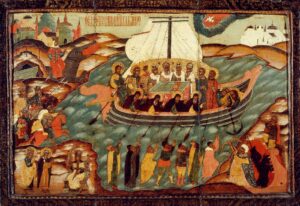
Above you see the Orthodox Ship sailing unperturbed past all the heresies and threats of the world. What this image does not show is the squabbling that sometimes occurs on board! – which at the moment, as I say, is much worse than usual. Despite that, the Ship always stays steady. This is clear evidence that Orthodoxy triumphs not through any virtue or power of ours – God knows! – but by His grace and the power of His Holy Spirit.
This is what our Lord prayed for His Church: “that they all may be one, as You, Father, are in Me, and I in You; that they also may be one in Us, that the world may believe that You sent Me.” John 17:21 This is the Triumph of Orthodoxy.
This Sunday as we march around our churches, we are not just carrying our icons, as they carried them into Aghia Sophia twelve centuries ago. We are carrying the Orthodox Faith – undefiled, triumphant and enduring – on into the 21st Century.
For as we proclaim at the end of the great Procession of Icons:
“This is the Faith of the Apostles, this is the Faith of the Fathers, this is the Faith of the Orthodox, this is the Faith which has established the Universe.”
Next Week: Second Sunday of Lent – Saint Gregory Palamas
Week after next: Third Sunday of Lent – Sunday of the Holy Cross