But before we begin:
1 The husband of one of our readers wrote this Haiku (a Japanese form of poetry) after the ICE murder of Alex Pretti, which I think is worth sharing:

They shot him 10 times.
It was 10 degrees outside.
That is such cold blood.

2 Valentine’s Day is tomorrow. When I was young, February 14 was still usually referred to as Saint Valentine’s Day. Saint Valentine, Martyr of Rome, is commemorated on the Latin calendar on February 14. There are some myths about his connection with romance. However, the fact is that over the years he got intermingled with Lupercalia, February 15, a Roman fertility festival (the details of which you’re better off not knowing), and that led to today’s less pornographic hearts and flowers and cupids and what not. Hooray for love! but it doesn’t really have any connection with Saint Valentine. In Orthodoxy, we celebrate Saint Valentine of Rome on July 6, apparently the date some of his relics were taken to Athens, and also another Saint Valentine on July 30. On the Orthodox calendar, February 14 is the feast of Holy Father Auxentius of the Mountain, Cyril, Equal-to-the-Apostles & Teacher of the Slavs, Nicholas the New Martyr of Corinth, and Abraham, Bishop of Carrhes in Mesopotamia. Try celebrating that with your sweetheart!
Pre-Lent
Here’s where we are:
February 15 is Meatfare Sunday, the last day for meat till the Paschal Feast.
Next Sunday is Cheesefare Sunday, the last day for cheese, milk and milk byproducts, as well as fish, wine and oil.
Monday February 23: The Great Lenten Fast begins. Roots ’n’ berries till Pascha. (New Orthodox: I’m jesting.)
In this Post we’ll touch on a few things we mentioned last week, for the sake of new readers, as well as any regular readers who missed last week’s article – and aren’t you ashamed of yourselves?
More from Saint Paul about Fasting
Why does meat go off before Lent begins? Because the Orthodox Church leads us into all things gently. * No instant salvation here, nor instant Lent, as you see.
- With the exception of Pascha (Easter) which arrives with a sudden explosion of joy.
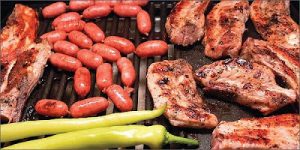
So last week was fast-free. (Sorry if you missed it. Come back next year.) This week we have returned to the usual Wednesday/Friday meatfast. On Meatfare Sunday we take our next step. Some churches have a great “meatfeast”, when we bring meat to church to devour at coffee hour. “Gather ye bratwursts while ye may.” (That’s a local Wisconsin sausage, if you didn’t know.)
So let’s pick it up where we left it last week, and let Saint Paul tell us more about fasting.
Epistle: I Corinthians 8:8 – 9:2
With all our emphasis on Lenten fasting, why ever do you suppose the Church Fathers chose this Epistle for today? in which Saint Paul says, “Food does not commend us to God” one way or the other. God isn’t impressed whether we eat or don’t eat – hardly designed to encourage us to fast!
Here’s the explanation. Our Orthodox lectionary has changed very little since Patristic times. The Fathers were aiming these Pre-Lenten readings at a society where almost everybody fasted.
In fact, almost everywhere in the world at every time in every culture in every religion, people have practiced religious fasting. That is, up until modern times in our culture where most people think fasting for spiritual reasons is just silly. For physical health, yes. For spiritual health, no way.
How very odd. For in recent times Western society haa learned again to think holistically, to see the inter-connectedness of soul, mind and body. So why do so few people now see the connection between spiritual health and fasting and, far more importantly, sexual morality (in last Sunday’s Epistle: 1 Corinthians 6:12-20). But that’s our modern world: disjointed and inconsistent.
Anyway, this Epistle was directed at people who took fasting for granted – as I think, I hope, most Orthodox people still do – and were tempted to over-emphasize it. The Fathers’ purpose was to point out the dangers in fasting, of thinking Jesus will say to me “Wow! he didn’t eat that cheeseburger! What a wonderful holy person he is!” I don’t think so. They are warning us that merely fasting from food does not make for a good Lent.
How does our Fasting or not Fasting affect others?
Whether we eat or don’t eat may not impress God. However, Saint Paul’s warns us here about something we rarely think about. “Beware lest somehow this liberty of yours become a stumbling block to those who are weak.” This is the real issue. The greatest virtue is not fasting but love, caring about people.
He was thinking here about whether Christians should or should not eat meat offered up in pagan temples. What if a new brother or sister saw you eating it and concluded pagan worship was ok?

That’s not a current issue, so let’s take another example. One Wednesday I took a guy who was considering Orthodoxy out to lunch, so we could talk. Among other things, we spoke about the Wednesday/Friday meatfast. I finished the last bite of my pepperoni pizza. (I’m putting this image here so I can drool over it while I can.) He departed. Then I realized what day it was. He didn’t say a thing about it, but I never heard from him again, and I’ve always wondered if that was why – he decided I was faking it. What if someone weak in faith or new to Orthodoxy sees you eating a hamburger during Lent and concludes these Orthodox are only playing games.
Paul concluded, “Therefore if [my eating] food makes my brother stumble, I will never again eat meat.”
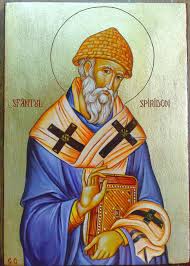
Let’s take it another way. Once during Lent Saint Spyridon (d. 348) had an unexpected visitor, a man who had come a long way and was famished. Spyridon ate almost nothing during Lent and had no food around except some old dried salted pork. He offered the man the pork. He refused it: it was Lent. So Spyridon during Lent ate some meat first, so the man would feel comfortable. Then the visitor ate.
Lenten rules don’t come first. People come first.
In fact, everything we do affects others. My good health – my vision and my ability to get around – depends on my taking daily meds. If I don’t take them and get seriously ill, it would affect not only me; it would put a burden on my wife and family, on my ability to assist with our many newcomers at church, and – alas! – I could no longer write this Blog.
Just so with my spiritual health. If I don’t pray, don’t fast, that is not just my business. It pulls everybody down, the whole Church, the entire Body of Christ, indeed the whole world. Because, brothers and sisters, we are all in this together. John Donne wrote: “No man is an island complete in itself. Each is a piece of the continent, a part of the whole. If a clod is washed away by the sea Europe is the less. Each man’s death diminishes me, for I am involved in mankind. Therefore send not to know for whom the bell tolls: it tolls for thee.”
What Jesus Christ said about Fasting
Very little, actually, but what He said was significant.
Why do we put such emphasis on such a seemingly little thing as fasting? Because Jesus told the Apostles that the way to cast out evil is “through prayer and fasting.” Matthew 17:19-21 Prayer and fasting are not little things: they are medicine to help cure our spiritual sickness and make us healthy and strong.
Besides, here was Christ’s teaching about little things: He criticized the Pharisees for keeping little rules (tithing on cooking herbs and the like) but ignoring the great things: mercy, justice, faith. But then He concluded: “You ought to do the one without neglecting the other.” Matthew 23:23 “Whoever can be trusted with very little can also be trusted with much.” Luke 16:10 Love people and keep the Fast. Why should anyone think these are mutually exclusive?
What Christ did not say about Fasting is also significant. Fasting was part of Judaism, and the Lord did not condemn it (as He might have) but rather took it for granted. In the Gospel for the Sunday before Lent He said not “if you fast” but rather “when you fast”. He also spoke of some other dangers of fasting. We’ll say more about that next week.
Building on this foundation, the Church also took fasting for granted, and quickly rules for fasting were developed. When some Christians later made fasting into a legal moral issue, it became something of an idol. * But when fasting has been used simply as a means for spiritual growth, it has remained a good and useful thing.
- Some believed eating meat on Friday was a mortal sin which, if not confessed, would send a person to hell. Really!
To repeat: Some general advice about Fasting aimed chiefly at new Orthodox
Try to keep the Fast with the Church, but don’t feel you must be rigid about it. Remember, the Orthodox Church gives us fasting rules, not fasting laws. If fasting is new to you, work into it gradually over the years. Make sure you get your protein and calcium. Feel free to make necessary adjustments: for age whether young or old, * pregnancy, travel, family situations, health. Don’t make yourself sick, as young John Chrysostom did, by overdoing it. (He never completely recovered from it.) It’s between you and God. If you have questions, ask your pastor.
- Our Deacon John (+) in his latter years tried to keep the full Fast before Communion, and twice he fainted, which was not spiritually edifying to anyone! I said “Jack, eat some breakfast” which he did.
We’ll say still more about Fasting next week. But if you want far better advice on fasting, stop reading this Blog and see what Saint John Chrysostom wrote, after he got older and wised up: http://www.orthodox.net/articles/true-fasting-saint-john-chrysostom.html
Moving on, this Sunday is also:
The Sunday of the Judgment
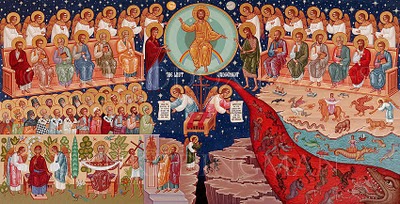
Matthew 25:31-46: “When the Son of Man gathers all nations before him he will separate them as a shepherd separates sheep from goats.” It will be the time for the Last Judgment.
Thank God there will be judgment! Look around at the state of the world, at the state of our country, today. Do we want things to go on like this forever? where evildoers get away with it? where good people suffer, are oppressed, persecuted?
Saint Basil’s Divine Liturgy, which we serve on Lenten Sundays, tells us “He will come to render to each according to His works.” * That’s clearly what Christ taught in today’s Gospel reading. How we act now is having eternal consequences.
- I don’t understand how “salvation by faith alone” Protestants deal with this.
Christ taught that in the End there will be only two options: Heaven or Hell. There is a Kingdom prepared for the sheep of his flock, with abundant unending life, fresh pastures, eternal spring, joy with the Lord and all who love Him. As for the rebellious goats: “Depart into the everlasting fire prepared for the devil and his angels”.

Eleven times in the Gospels, Christ warned of the fire of “Gehenna”. He was referring to the valley of Gehenna (now called “Hinnon”) down below Jerusalem – the city garbage dump, from which smoke was always rising as the refuse was destroyed. Hell is the eternal garbage dump for those who proved finally to be worthless, not worth saving.
- now called “Hinnon”, and all cleaned up, as you can see
That, in the most basic sense, is what “being saved” means: “not being thrown out” in the Final Housecleaning. * In the End, for you and for me, it will be eternal joy above in the Holy City with Jesus, or unending destruction down below.
- having been “made righteous”, into the kind of people God made us to be, worthy of saving.
Must we believe in the existence of Hell? Yes. Christ taught it plainly many times. But, as someone said, we are not required to believe anybody is in it! It is hard to imagine how anyone could finally stand before Jesus Christ, look God in the face, see His beauty, His love, His mercy, His goodness – and reject Him. Saint Gregory of Nyssa hoped that in the end everyone, even the devil and his angels, may be redeemed. I like that. But I think the Scriptures teach that while Satan could be redeemed, he won’t be. He will reject it. That could apply to some people, too – once they could have been saved, but now they’re too far gone to turn around and repent – though that’s not for us to judge.
God doesn’t force Heaven on us. Where we finally go is our choice. We are deciding now. C.S. Lewis wrote (in The Great Divorce) that in the End we – imperfect though will still be – will either say to God, “Thy will be done”, or He will reluctantly say to us, “Your will be done. If you don’t want Me, you needn’t have Me. I won’t force you.”
Jesus Christ will be the Judge of it all. This is His consistent teaching: John 5:22-27, for one example.
And here is the standard of judgment: “If you did it to the least of these my brethren, you did it to me..… If you failed to do it to the least of these my brethren, you failed to do it to me.” The sick, the lonely, the hungry, the poor, the helpless, the hopeless, the abandoned ones, refugees, the children of refugees, so many people, so many kinds of needs.
I hesitate to get into contemporary events here… however: Two things:
1 America now has so many billionaires and even trillionaires living in palatial estates, gadding about in private planes to exclusive resorts, some with the likes of Jeffrey Epstein, when they could be doing so much to alleviate the suffering of so many people. 10% of Americans – 35 million people – live below the poverty level.
2 For decades, because of governmental dysfunction, America has had no way to deal with people at our borders. Are they genuine refugees? Have they been persecuted, threatened with murder? Are they political refugees, driven out of their own countries? Are they poor, just looking for a place where they can work and support their families? * Or are they criminals? Who knows? So now we just shut them all out, ignoring Jesus Christ in the least of his brothers and sisters.
- As my ancestors were. (Were yours?) Also they didn’t want their sons to die in Bismarck’s wars.
There are also needy people close to us – husbands, wives, children, family, friends, co-workers, bosses, people who stand beside us in church, clergy, even bishops. Sometimes it’s the ones closest to us that we miss. And often what’s asked of us is not difficult. Maybe all they need is a smile or a kind word. But how easily we pass by.
The judgment on the wicked will be on what they did not do – sins of omission. They failed to love, to care.
Who will be saved.
Listen very carefully. This is extremely important.
This parable teaches very clearly that the Judgment will not be on whether you had a “got saved” or “born-again” experience or publicly “gave your life to Jesus”. If you think you are guaranteed of salvation, think again. Nor does your salvation depend on whether you believed the right doctrines, or what church you belonged to, or even on what religion you belonged to, or whether you had any religion at all. For the parable describes the Judgment of the “Nations”, all people, Gentiles, non-believers. Christ teaches here that all that will all get straightened out in the End, when all will see Him face to face and know who he is, and all will believe.
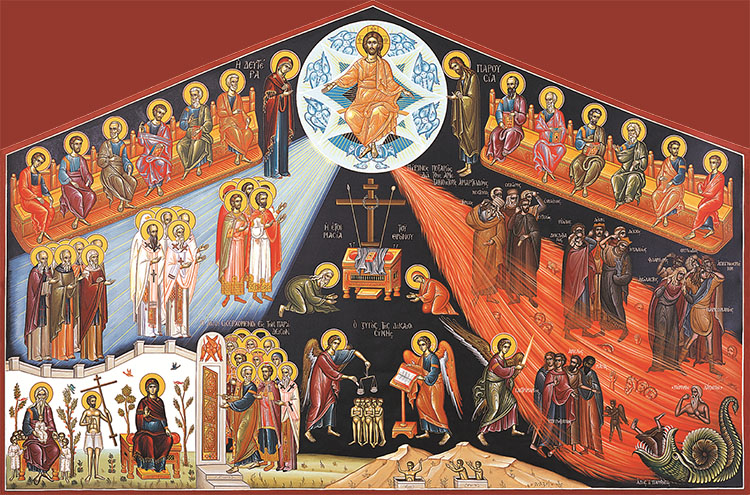
And our Lord Jesus Christ teaches here that in the End it will turn out that many non-Christians had been serving Him, but just didn’t know it yet – and in they will come.
There will be others, “fake” Christians who were not serving Christ – for how could they have been following Jesus and then treat people like that? Did they never listen to what He said about being merciful and generous and compassionate, about loving our enemies, doing good even to those who hate us? but instead they ignored and even mistreated and persecuted people. Surely they knew what Jesus said, that they were mistreating and persecuting Him. And out they will go.
As Christ often said, in the End “many who were first will be last, and the last first”. But this is not for us to judge. He is the Judge.
But (now listen even more closely)… does this mean, then, that Christian doctrine has nothing to do with our salvation? Yes, indeed it does… for true Christian doctrine is that we are saved by love, not by doctrine.
Next Week: Cheesefare Sunday: Forgiveness Sunday
Week after Next: The Triumph of Orthodoxy