The Jews don’t often say it, but they think we’re idolaters: that we worship a man, Jesus of Nazareth. For there is only one God.
The Muslims say we’re polytheists: that we worship three Gods, Father Son and Holy Spirit. For there is only one God.
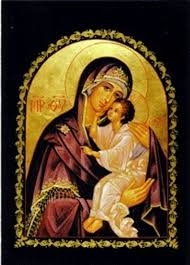
He looks like any other child. What ever would cause anyone to believe this little Boy is “the only Son of God, eternally begotten of the Father, God from God, Light from Light, true God from true God, begotten, not made, of one Being with the Father. Through him all things were made”? Through Him all things were created?
Nevertheless, we sing about it at every service. Listen to the Theotokion for the Divine Liturgy of Saint Basil: He “Who is our God before the ages” was “made flesh and became a little Child – He made your womb a throne, and He made it wider than all the heavens.” God dwelt in her womb. God nursed at her breast. Her little Boy Whom she loved so much was God.
God, by definition, is all-seeing, all-knowing. Are we saying the embryo in Mary’s womb saw all things, knew all things? Of course not.
To make sense of this seeming absurdity, we have to read to the conclusion of Our Lord’s short life on earth, then look back.

But let’s begin at the beginning. Remember, Jesus was not only Son of God. He was also fully human. Later, His Mother told Saint Luke how the Boy “grew and became strong”. In His humility, He went through all the phases of what it means to be a human being. He had a normal human childhood. Luke 2:40
By age 12, Jesus knew Who He was. Remember the story of how his parents took Him to Jerusalem for the Passover Festival, and how they lost Him and finally found Him in the temple. “Son, why have you done this to us? Your father and I have been looking anxiously for you.” He responded: “I must be in my Father’s House.” * It shocked them. They didn’t expect Him to know so soon. It says at first they didn’t understand what He meant – but He did. He knew. But then He went back to His boyhood. “Jesus continued to grow in wisdom and stature.”Luke 2:52
- It can also be translated “I must be about my Father’s business.”
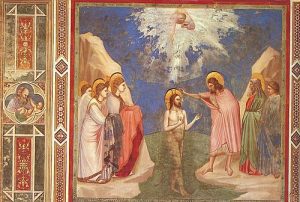
Jewish men in the First Century typically married in their late teens or early twenties. Why did Jesus wait another full 18 years before He began His public ministry? My guess is that He needed to be absolutely sure within Himself of Who He was. This would certainly not be an easy conclusion to accept! especially as He came to realize what it would require of Him. Finally, at age 30, He came out in public, was Baptized and heard the words of His Father confirm it: “You are my beloved Son. I am well pleased with You.” Even after that, when He went into the wilderness to be tempted, remember the devil’s first temptation: “If You are the Son of God…” I think he was trying not only to find out for himself, but also to determine whether Jesus was really sure within Himself.
He was. For immediately after this our young Lord began saying and doing things which belong only to God, astounding those who knew Him well, appalling those who did not, and challenging the religious authorities. He presented Himself not only as Israel’s long-awaited Messiah, but also as the Son of God – “of the same divine nature as God”, just as a human son is of the same human nature as his father.
Read the Gospel accounts. I have been reading the Gospels for many decades now, and still I discover things that startle me.
Let’s take a few examples, beginning with the first of the Gospels:
Matthew 5:17: “Do not think that I came to destroy the Law or the Prophets. I did not come to destroy but to fulfill.” Who is this who says He “came” from Somewhere else, who claims He fulfills God’s Law?
Matthew 6:21-22: “You have heard that it was said to those of old, ‘You shall not murder, and whoever murders will be in danger of the judgment.’ But I say to you that whoever is angry with his brother without a cause shall be in danger of the judgment…” 4:27-28: “You have heard that it was said to those of old, ‘You shall not commit adultery.’ But I say to you that whoever looks at a woman to lust for her has already committed adultery with her in his heart.” What was “said to those of old” was God’s Law delivered to Moses! which Jesus here fulfills, revises, corrects! “But I say to you…” How dare He?

He prohibits the established Jewish way of fasting. Matthew 6:16-18: “Moreover, when you fast, do not be like the hypocrites, with a sad countenance. For they disfigure their faces that they may appear to men to be fasting. Assuredly, I say to you, they have their reward. But you, when you fast, anoint your head and wash your face, so that you do not appear to men to be fasting, but to your Father who is in the secret place; and your Father who sees in secret will reward you openly.”
He claims He will be Judge at the Last Day. Matthew 7:21-23: “Not everyone who says to Me, ‘Lord, Lord,’ shall enter the kingdom of heaven, but he who does the will of My Father in heaven. Many will say to Me in that day, ‘Lord, Lord, have we not prophesied in Your name, cast out demons in Your name, and done many wonders in Your name?’ And then I will declare to them, ‘I never knew you; depart from Me, you who practice lawlessness!’”
Matthew 8:1-16: He possessed astonishing powers to heal, even from a distance. In front of Peter’s home in Capernaum, he healed “all who were sick”. Matthew says He fulfilled a prophecy: “He Himself took our infirmities, and bore our sicknesses.”
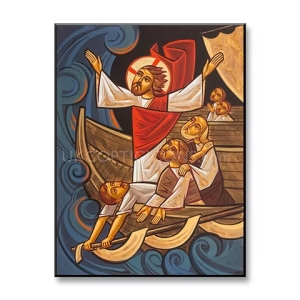
Matthew 8:23-27: This episode directly raises the Big Question. Caught in a storm at night on the Sea, “He arose and rebuked the winds and the sea, and there was a great calm. So the men marveled, saying, ‘Who can this be, that even the winds and the sea obey Him?’”
Matthew 8:28-29: The demons know Who He is. The demon-possessed men cry out: “What have we to do with You, Jesus, You Son of God? Have You come here to torment us before the time?” And He has power over them. He casts them into a herd of pigs who run over a cliff and into the Sea.
Matthew 9:1-8. He heals a paralytic saying “Son, be of good cheer; your sins are forgiven you.” At once some of the scribes said within themselves, “This Man blasphemes!” Blasphemy, because only God can forgive sins. Jesus responds: “But that you may know that the Son of Man has power on earth to forgive sins”—then He said to the paralytic, “Arise, take up your bed, and go to your house.” And he arose and departed to his house.
Two points here: 1) Jesus claims the divine power to forgive sins. 2) The title “Son of Man”, which people often interpret to mean He is human.
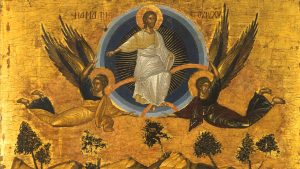
It means far more than that. In the book of the Prophet Daniel (7:13-14): “I saw in the night visions, and behold, with the clouds of heaven there came one like a son of man, and he came to the Ancient of Days and was presented before him. And to him was given dominion and glory and a kingdom, that all peoples, nations, and languages should serve him; his dominion is an everlasting dominion, which shall not pass away, and his kingdom one that shall not be destroyed.”
We’ve only begun to delve into one Gospel account. You get the point: Jesus made so many claims and did so much that belong only to God. When we who believe read the Gospels we take this for granted: Jesus is Son of God, so of course He can say and do these things. But they shook His disciples to the core, as they tried to make sense of it, of Him, because Jews, of all people in the world, knew clearly that there is one God and one God only.
That was why He chose to be born as a Jew. If He had been born into the pagan world, people would have said “Ah! another god for our pantheon. Let’s light another candle.” But if only a few Jews could recognize Him as God, He, in some inexplicable way, would have to be The God, the One God, the Source and Ruler of All, somehow walking in their midst.
Let’s move over to John’s Gospel account and the middle of Christ’s brief ministry. His reputation has spread far and wide by now. Many were believing, and He was becoming a threat to the “establishment.” Jesus went up to Jerusalem for the Feast of the Dedication, where He made His boldest claims:
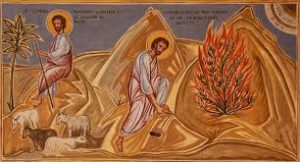
“You are not yet fifty years old,” they said to him, “and have you seen Abraham?”“Very truly I tell you,” Jesus answered, “before Abraham was born, I am!” * At this, they picked up stones to stone him, but Jesus hid himself, slipping away from the temple grounds. John 8:57-58
- When Moses saw God in the burning bush, he asked Him to identify Himself. God answered: “I am who I am.”
Later: “I give [my followers] eternal life, and they shall never perish; neither shall anyone snatch them out of My hand. My Father, who has given them to Me, is greater than all; and no one is able to snatch them out of My Father’s hand. I and My Father are one.” Some of the Jews took up stones to stone Him “for blasphemy, and because You, being a Man, make Yourself God.” But He quietly escaped. John 10-28-30
You know the story of Christ’s Passion, Crucifixion and Resurrection. Before the Sanhedrin, the Jewish high court, finally the high priest asked Him, “Tell us if You are the Christ, the Son of God!” Jesus said to him, “You have said it.” * Nevertheless, I say to you, hereafter you will see the Son of Man sitting at the right hand of the Power, and coming on the clouds of heaven.” Then the high priest tore his clothes, saying, “He has spoken blasphemy! … What do you think?” They answered and said, “He deserves death.” Matthew 26:63-64
- a way of saying “It is as you said.”
And that is why they had Him crucified, executed, killed, eliminated – because He claimed to be equal with God. They did the worst they could do to prove Him wrong. And it didn’t work. On the third day He rose again. He couldn’t be put down. Jesus was Who He said He was.
He appeared chiefly to those who had known Him all along, to those who, despite every Jewish bones in their bodies, would be forced to come to the obvious conclusion: He was Who He said He was.
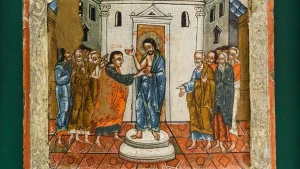
The Apostle Thomas was the first to say it plainly, when He appeared to His disciples on the second Sunday night after His Resurrection: “You are my Lord and my God!”
The New Testament writers and early Christian fathers struggled to find words adequate to express this inexplicable thing. Listen to Saint Paul:
“Have this mind among yourselves, which was in Christ Jesus, who, though he was in the form of God, did not count equality with God a thing to be grasped, but emptied himself, taking the form of a servant, being born in the likeness of men.” Philippians 2:5-6
How could this be? How could God be present both in Heaven and on earth, both in the Father and the Son?
It took the Church three centuries before a description became fixed in the Nicene Creed: “one Lord Jesus Christ, the only-begotten Son of God, begotten of the Father before all ages; Light of Light, true God of true God, begotten, not created, of one essence with the Father through Whom all things were made. Who for us men and for our salvation came down from heaven and was incarnate of the Holy Spirit and the Virgin Mary and became man.”
Do those words explain the Mystery? No. That is beyond our understanding. They only describe the inexplicable.
Now, back to the beginning:
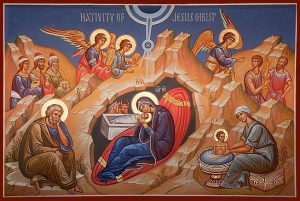
Take the Gospels seriously and there can be no other possible conclusion: That little Baby lying in the crib is “Son of God… Light from Light, true God from true God… of one essence with the Father”.
However, beginning with Arius in the Fourth Century off and on down to modern times, there have been more than a few who have accepted Christ’s teachings but denied His divinity. Here is how C.S. Lewis dealt with that problem in his book Mere Christianity.
“I am trying to prevent anyone saying the really foolish thing that people often say about Him: ‘I am ready to accept Jesus as a great moral teacher, but I do not accept His claim to be God.’ That is the one thing we must not say. A man who was merely a man and said the sort of things Jesus said would not be a great moral teacher. He would either be a lunatic–on the level with the man who says he is a poached egg–or else he would be the Devil of Hell. You must make your choice. Either this man was, and is, the Son of God, or else a madman or something worse. You can shut him up for a fool, you can spit at him and kill him as a demon, or you can fall at his feet and call him Lord and God. But let us not come up with any patronizing nonsense about his being a great human teacher. He has not left that open to us. He did not intend to. We are faced, then, with a frightening alternative. This man we are talking about either was (and is) just what He said, or else a lunatic, or something worse. I have to accept the view that He was and is God.”
Next Week: What we never hear in church
Week after Next: The Redemption of Creation